
Cold Email Reply Templates: What to Send Back for Every Type of Reply You Get
You sent the cold email, it worked, and now there is a reply sitting in your inbox. The hard part is supposedly over, but this is where most pipeline quietly leaks. The prospect said “what does it cost” or “not right now” or “you want someone else on my team,” and you are staring at the blank reply box trying to find the right words before the moment cools. The cold email reply templates below fix that. They give you a ready first line for every common response, so you answer fast, keep the thread moving, and stop losing warm leads to a slow or clumsy reply.
Almost every “cold email template” article on the web is about the first touch, the message that earns the reply. Very few cover what to say once someone actually writes back. That is the gap this post fills: a reply-response library organized by the type of reply you receive, with the exact words to send and the reasoning behind each one.
How to use these cold email reply templates
A template is a starting point, not a script you paste verbatim. Three rules make all of them work:
- Match their energy and length. A two-line reply deserves a two-line answer, not a five-paragraph essay. When a prospect writes short, writing long reads as desperate.
- Make the next step a single, easy yes. Every reply should end with one clear ask the prospect can answer in one line. Two questions and an attachment is friction. One specific question is momentum.
- Speed beats polish. A good reply in ten minutes outperforms a perfect reply the next afternoon. We broke down why in how five-minute response times increase conversions. Interest has a short shelf life, so send before it fades.
Keep those three in mind and adapt the wording to sound like you. Now, the templates.
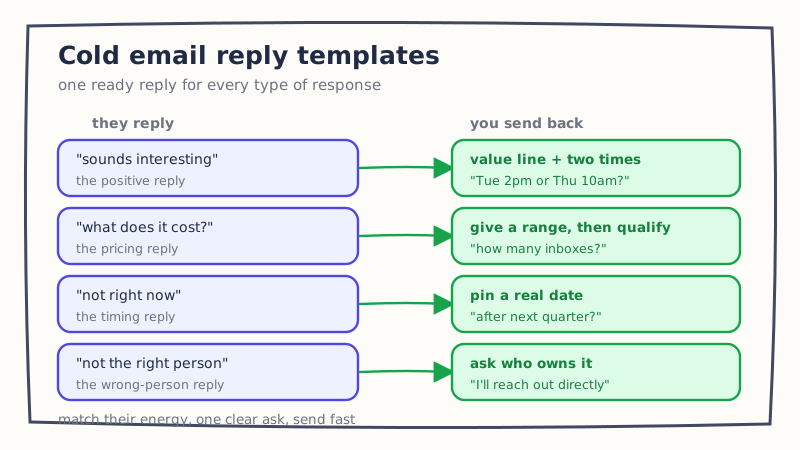
”Sounds interesting” or “Tell me more” (the positive reply)
This is the reply you wanted, and the most common way teams waste it is by answering a warm human with a cold calendar link. Acknowledge the interest, give one sentence of specific value, and propose two concrete times.
Hi [Name], glad it landed. In short, we [one-sentence outcome tied to their role], without [the thing they currently hate]. Worth a quick 15 minutes to see if it fits? I have Tuesday at 2pm or Thursday at 10am ET, either work?
Two named times beat an open booking link because they remove the decision. For the full playbook on not fumbling the best reply you will get, see how to respond to positive cold email replies.
”What does it cost?” (the pricing reply)
A pricing question this early is a buying signal, not a negotiation. The mistake is dumping a full price list and letting the number do your qualifying for you. Give a range to stay honest, then pivot to the one variable that actually sets their price.
Great question. It usually lands between [low] and [high] per month depending on [the one real driver, like seats or send volume]. Rather than guess, can I ask how many [inboxes/reps/contacts] you are working with? I will send a number that actually reflects your setup.
You answer the question, show you are not hiding the ball, and earn the context you need to quote well. More on defending the deal while talking money in how AI reply agents handle pricing questions without killing the deal.
”Send me more info” (the deck request)
This reply is ambiguous. Some prospects genuinely want a one-pager to forward internally; others are politely brushing you off. Do not send a 30-slide deck into the void. Offer something small and use it to qualify intent.
Happy to. So I send the right thing and not a generic overview, what is the main outcome you are hoping to improve, [faster replies, more booked meetings, less manual inbox work]? I will put together a short one-pager focused on that and include a two-minute walkthrough.
If they answer, they are real and you have learned their priority. If they go quiet, you saved yourself a deck. Full breakdown in handling “send me more info” replies.
”Not right now” or “Circle back later” (the timing reply)
A deferral is not a rejection, and treating it like one burns a future deal. Acknowledge the timing, pin down a real date, and give them a reason to remember you when it arrives.
Totally fair, timing is everything. When would be a better moment to reconnect, after [their event, like your next quarter or a product launch]? I will set a reminder and send one genuinely useful [benchmark/resource] in the meantime, no pitch attached.
Getting a specific month beats a vague “reach out later” that never resolves. We cover the timing signal in depth in how AI reply agents handle “not right now, circle back later” replies.
”We already use [competitor]” (the incumbent reply)
Do not attack their current tool; you will only make them defend it. Acknowledge the incumbent, plant one specific point of difference, and ask a low-pressure diagnostic question.
Makes sense, [Competitor] is solid for [what it does well]. Most teams we talk to kept it and added us for [the specific gap, like handling replies after hours or across multiple inboxes]. Out of curiosity, how is [that exact thing] working for you today?
This reframes you as complementary, not a rip-and-replace fight, and the question surfaces whether a real gap exists. More on this in handling “we already use a competitor” replies.
”Not interested” (the soft no)
Most “not interested” replies are reflexes sent before the person read closely. You will not win all of them, and you should not try hard. Send one respectful, curiosity-led line and then let it go.
Appreciate the honesty, [Name]. Quick one so I can improve my aim: was it the timing, the fit, or just not a priority right now? Totally fine either way, and I will not keep emailing.
The explicit “I will not keep emailing” lowers the cost of replying, which is exactly why some people then tell you the real reason. Turning a flat no into signal is the whole subject of how to handle objection replies in cold email.
”I’m not the right person” (the wrong-person reply)
This is one of the highest-value replies you can get, because the prospect is offering to point you at the decision maker. Make the handoff effortless and never make them do the work of an introduction they did not volunteer for.
Thanks for flagging, [Name], I appreciate you taking the time. Who owns [the relevant area] on your side? If it is easier, I am happy to reach out directly and leave you out of it entirely.
Offering to take it off their plate gets you the name far more often than asking for a formal intro. See how to handle wrong-person replies and route to the decision maker.
”I’ll pass this along” (the referral reply)
When someone offers to forward you internally, your job is to arm them with something easy to forward and easy for the next person to act on.
That would be a huge help, thank you. To make it easy to pass along, here is the one-line version: [a single clear sentence they can paste]. Happy to loop in [the colleague] directly too if that is simpler, whatever is least work for you.
A forwardable one-liner travels; a long email dies in the forward. More on converting these in handling referrals and warm introductions.
The auto-reply (out of office)
An out-of-office is not a real reply, so do not treat it like one. Do not pitch a bot. Note the return date, suppress the thread until then, and follow up once the person is back.
The mistake is a sequence blindly firing the next touch while the prospect is on a beach, so they return to three stacked messages and unsubscribe. Detect the auto-reply, pause, and resume cleanly. The mechanics are in handling out-of-office replies and follow-ups.
The real problem is not the words, it is doing this every time
Every template above is simple. The hard part is applying the right one, within minutes, to every reply, across every inbox, every day, for months. A rep handling replies between meetings will nail the loud threads and quietly miss the rest. The “circle back in Q3” reply that needed a reminder, the wrong-person reply that needed routing, the warm “interested” that needed an answer in ten minutes and got one in ten hours. That is where pipeline leaks, and no template fixes a reply that never gets sent.
This is exactly what an AI reply agent is built to do. It reads each incoming reply, classifies the type, drafts the on-brand response that matches the situation, and sends or routes it in seconds, around the clock, at whatever volume your campaigns produce. The templates become a system that runs itself instead of a document nobody opens. If you want to see how automated reply handling fits into one inbox, the Underfive features page walks through it, and our guide on how to respond to cold email replies covers the principles behind every template here.
Start with your last ten replies
Do not wait for a perfect system. Open your inbox, find the last ten replies you received, and match each to a template above. Send the ones you never got around to. You will likely reopen at least one thread you had written off, and you will feel exactly where the manual version breaks. That breaking point is the signal that it is time to let reply handling run on its own.