How AI Reply Agents Handle ‘We Already Use a Competitor’ Replies
Ask any SDR which reply they dread most and you will hear some version of the same thing: “Thanks, but we already use [competitor].” It arrives polite, final, and deceptively easy to accept. Most reps read it as a no, type “totally understand, I will check back in six months,” and move on. The thread goes cold and the lead is filed under “happy with current solution” forever.
That is a mistake. A prospect who already uses a competitor is not unqualified. They are pre-qualified. They have a budget line, an admitted need, and a tool they chose at some point in the past that may no longer fit. The incumbent objection is not a wall. It is a checkpoint, and the way you reply to it decides whether the conversation continues.
This is exactly the kind of nuanced, high-stakes reply that Underfive’s Unified Inbox is built to handle. Below is how a well-configured agent reads the objection, responds in seconds, and turns “we already have one” into a booked meeting, without ever sounding like a script.
Why the incumbent objection is really a buying signal
When someone tells you they already use a competitor, they have just handed you three valuable facts for free:
- They have the problem you solve. Nobody buys a tool for a problem they do not have.
- They have budget. The hardest part of a deal, getting money approved, is already done.
- They have a baseline to compare against. You are no longer selling a concept. You are selling a delta.
The only thing standing between you and a conversation is inertia. People do not switch tools because something better exists. They switch when the cost of staying becomes visible. Your reply has one job: make that cost visible without attacking the choice they already made.
Human reps struggle here for two reasons. First, the objection usually lands hours or days after the original send, so the rep has lost context and momentum. Second, replying well requires emotional discipline. The natural human reaction is to either give up or get defensive, and both lose. An AI reply agent has neither problem. It responds in minutes while intent is hot, and it never takes the objection personally.
The four-move reply that actually works
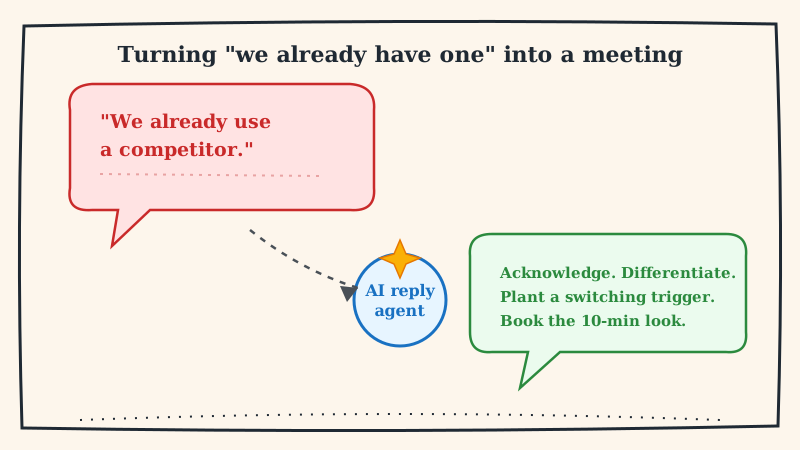
A strong response to the incumbent objection follows a predictable structure. Configure your agent around these four moves and it will outperform most live reps on this specific reply type.
Move 1: Acknowledge the incumbent sincerely
The fastest way to end a conversation is to trash the tool the prospect already chose. They picked it. Criticizing it criticizes their judgment. Instead, the agent should validate the choice and lower the temperature:
“Makes sense. [Competitor] is a solid choice for sending at volume, and plenty of teams run on it happily.”
This single sentence does more than sound polite. It signals that you are not a desperate vendor trying to win an argument, which makes the prospect more willing to keep reading.
Move 2: Reframe around a gap the incumbent does not cover
Now introduce the delta. The agent should not claim to be “better.” It should name a specific job the incumbent was never designed to do. For an AI reply agent, that gap is almost always the same: sequencers and inboxing tools are excellent at sending, but the moment a prospect replies, they hand the thread back to a human who is asleep, in a meeting, or buried in 80 other replies.
“One thing we hear from teams on [competitor]: it is great at getting messages out, but replies still pile up until someone gets to them. We handle the reply side specifically, so every response gets answered in minutes, day or night.”
This is not a feature war. It is a category distinction. You are not competing for the same slot. You are pointing at a slot the incumbent leaves empty.
Move 3: Plant a low-commitment switching trigger
Do not ask them to switch. Ask them to look. The agent should offer a trigger so small that saying yes costs almost nothing:
“Worth a 10-minute look at how it would sit alongside what you already run? No rip-and-replace, it just catches the replies your current stack drops.”
Notice the framing: “alongside,” not “instead of.” Most incumbent objections soften the instant the prospect realizes they do not have to tear anything out to test you.
Move 4: Make booking frictionless
The final move is the call to action, and it must remove every ounce of effort. The agent proposes specific times or drops a scheduling link, then stops talking. If you pair your reply agent with calendar-first booking from a tool like Kali, the prospect can lock a slot in two clicks without a single back-and-forth email.
A real before-and-after
Here is how the same reply looks handled by a typical rep versus an AI agent tuned for the incumbent objection.
Prospect: “Appreciate it, but we already use [competitor] for this.”
Typical rep, two days later: “No worries! I will circle back in Q3 to see if anything has changed.”
That is a dead thread. No reason to reply, no reason to remember you.
AI reply agent, four minutes later: “Makes sense, [competitor] is a strong sender and a lot of teams are happy on it. The one thing we hear is that replies still wait on a human, so fast-moving leads cool off before anyone answers. We sit on the reply side and respond in minutes, alongside your current setup rather than instead of it. Worth a 10-minute look next week? Tuesday 11am or Wednesday 2pm both work.”
One of these gets a meeting. The other gets archived.
Where teams get this wrong
Even with a reply agent in place, a few configuration mistakes will sink your incumbent-objection handling:
- Going negative on the competitor. If your prompt encourages the agent to “explain why we are better,” you will lose. Train it to differentiate, not denigrate.
- Asking for a switch instead of a look. A switch is a big yes. A 10-minute look is a small yes. Always optimize for the small yes first.
- Replying too slowly. The whole advantage of automation is speed. If your agent waits hours, you have recreated the exact problem you are selling against. Underfive’s inbox agents answer in minutes precisely because reply latency is where deals die. We covered this in depth in our piece on why 5-minute response times increase conversions.
- Ignoring deliverability. None of this matters if your reply lands in spam. Before you scale outbound, make sure the list you are sending to is clean. Running addresses through a validation tool like Scrubby keeps your sender reputation intact so your carefully crafted incumbent reply actually reaches the inbox.
Train the agent on your real switching story
The four moves above are the skeleton. The muscle comes from your specific differentiation. Sit down and answer one question: when a customer leaves a competitor for you, why do they leave? The reasons usually cluster around two or three repeating themes, like slow reply handling, no after-hours coverage, or threads that lose context across multiple stakeholders.
Feed those themes into your agent’s instructions as approved talking points. Then let it match the right one to each objection. A prospect who mentions they are “drowning in replies” should hear about reply speed. A global team should hear about 24-hour coverage. The agent’s advantage is that it can read the specific wording of the objection and select the most relevant switching trigger every time, something a tired rep working a list of 200 rarely does well.
You can layer this onto your existing setup. The agent reads the reply, recognizes the incumbent objection, picks the differentiation theme that best fits the prospect’s own words, and drafts the four-move response. You stay in control of the talking points. The agent handles the speed and the consistency.
The bottom line
“We already use a competitor” is not the end of a conversation. It is proof that the prospect has the problem, the budget, and a reason to be curious about a better way. The teams that win this reply are not the ones with the cleverest comebacks. They are the ones who respond fast, acknowledge the incumbent, point at a gap, and ask for a 10-minute look instead of a switch.
That is a repeatable pattern, and repeatable patterns are exactly what automation is good at. The inbox agents in Underfive’s Unified Inbox handle the incumbent objection the same disciplined way on reply number one and reply number five hundred, at 9am or 2am, while your reps focus on the meetings they book. Stop treating “we already have one” as a polite no. Start treating it as the most qualified lead in your inbox.