Who Should Approve AI-Drafted Cold Email Replies?
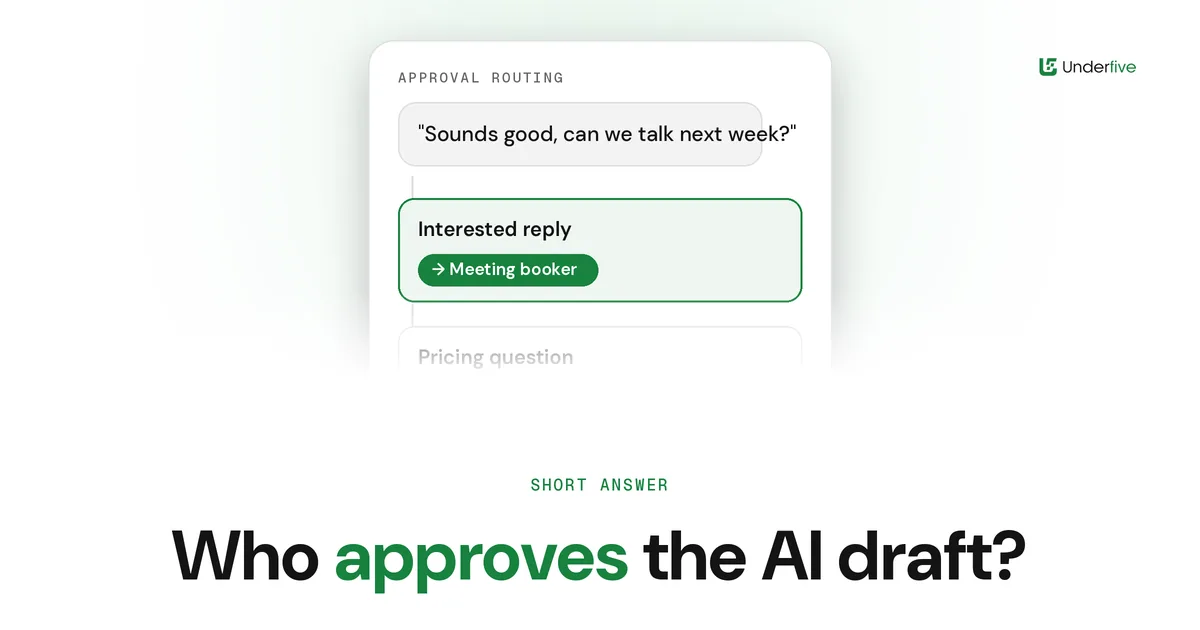
The person closest to the outcome of that type of reply should approve it, and every reply type needs a named backup. Interested replies go to whoever books meetings, pricing and objection replies go to a senior seller or founder, and angry, legal or unsubscribe replies go to one named owner. Splitting approval this way keeps it fast without putting risky replies in junior hands.
Why one approver for everything fails
Giving every draft to one person feels simple. It breaks quickly. That person becomes the bottleneck, drafts wait while they are in meetings, and the whole queue stops when they take a day off. They also end up approving replies outside their knowledge, such as a pricing answer when they do not set prices.
A simple split by reply type
| Reply type | Approver | Backup |
|---|---|---|
| Interested, wants to talk | SDR or meeting booker | Second SDR or sales lead |
| Pricing, terms, contracts | Founder, AE or account lead | Sales lead |
| Objection or competitor mention | Experienced seller | Founder or sales lead |
| Referral or wrong person | SDR | Any reviewer |
| Angry, legal, unsubscribe | One named owner | Ops or founder |
Pin this table in your approval channel so nobody has to guess.
Agencies: you or the client?
If you run outbound for clients, decide per client and write it down. Common setups:
- Agency approves everything. Fastest. Works when the client has signed off on approved answers in advance.
- Agency approves routine replies, client approves pricing and objections. A good middle ground for most clients.
- Client approves everything. Slowest. Only worth it for clients in sensitive industries, and only with a backup on their side.
Whichever you choose, give each client their own approval channel so drafts never cross over.
What the approver actually does
The approver does not rewrite. They read the prospect’s message, check the draft answers it, confirm the facts are right, make sure there is one clear next step, and then approve, edit or reject. Rejections get a one-line reason so the next draft improves.
Speed still matters
An approver who takes hours undoes the point of AI drafting. Set a response target for each reply type, send reminders to the backup when a draft sits too long, and decide in advance who covers evenings and weekends.
FAQ
Can some replies skip approval? Yes, once you trust them. Out-of-office replies and other low-risk types are often the first to move to auto-send under clear rules. Keep reviewing a sample.
Should the approver be the same person whose name is on the mailbox? Not necessarily. The reply goes out from the sending mailbox either way. What matters is that the approver knows the answer and the voice.
How many approvers is too many? If reviewers regularly are not sure whose draft it is, you have too many or the split is unclear. One owner and one backup per reply type is usually enough.
Where does Underfive fit? Underfive’s inbox agents draft replies in a unified inbox and send them to Slack, where the approver you choose for that reply type approves, edits or rejects them before anything goes out.
The bottom line
Approve by reply type, not by whoever happens to be online. Match each type to the person who knows the answer, name a backup, and keep the queue moving.