How AI Reply Agents Handle ‘You’ve Got the Wrong Person’ Replies
You sent a clean, well-targeted cold email to a name your data told you was the VP of Sales. A reply lands the next morning: “I don’t handle this anymore, you’ll want to talk to someone on the RevOps team.” Most reps read that, sigh, and mark the lead as bad data. The thread dies right there.
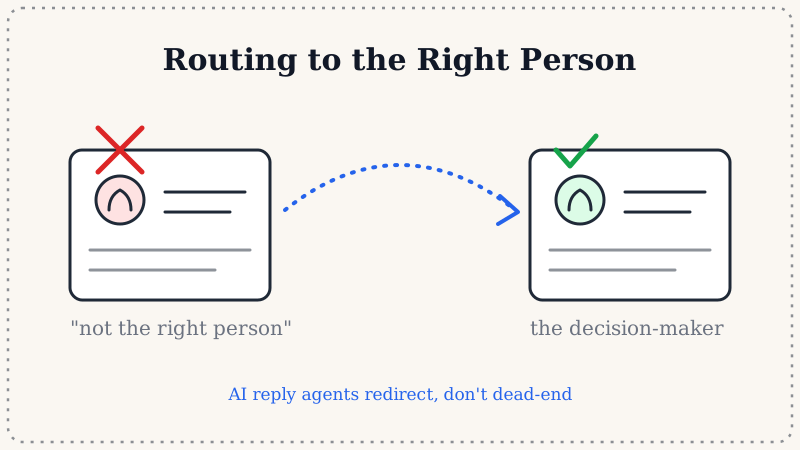
That is a mistake. A “wrong person” reply is one of the most valuable responses a cold email can earn. The prospect just did two things for you at once: they confirmed the company is real and reachable, and they pointed you toward the person who actually owns the problem you sell into. You did not get a rejection. You got a warm redirect, delivered for free by someone inside the account.
The trouble is that these replies are fragile. The window to convert a redirect into an introduction is small, and the tone has to be exactly right. This is a job an AI reply agent handles better than a busy human, because it never lets the thread go cold and never fumbles the ask. The inbox agents in Underfive’s Unified Inbox read the redirect, extract the new name, and either ask for a warm introduction or open a fresh, context-rich thread with the right person, within minutes.
Why ‘Wrong Person’ Replies Get Wasted
Sales teams leak an enormous amount of pipeline on wrong-contact replies, and almost always for the same three reasons.
They read it as a failure signal. The rep’s mental model is binary: a reply is either a yes or a no. “I’m not the right person” sounds like a no, so it gets filed next to “not interested.” But it is neither. It is a lateral move inside a live account, and it should raise the account’s priority, not lower it.
The follow-up never happens, or happens too late. Even reps who know the redirect is valuable rarely act on it fast. The reply sits in an inbox behind fifty others. By the time anyone circles back to ask for the introduction, the prospect who offered the redirect has forgotten the original email entirely, and the goodwill that would have carried a warm handoff has evaporated.
The handoff is done clumsily. When reps do follow up, they often botch the ask. They either put too much burden on the person who redirected them (“can you set up a call with three of your colleagues?”) or they cold-start the new contact with zero context, wasting the referral entirely. Getting the tone right, grateful, low-friction, and specific, is harder than it looks when you are rushing through a reply queue.
An AI reply agent removes all three failure modes. It treats a redirect as the high-intent event it is, it responds while the context is still warm, and it runs a handoff script that has been tuned to convert.
The Two Paths a Good Agent Chooses Between
Not every “wrong person” reply should be handled the same way. A well-designed agent reads the reply and picks one of two routes based on what the prospect actually offered.
Path 1: Ask for the warm introduction
When the person who replied seems willing and connected to the right contact, the highest-converting move is to ask them to make the introduction. A warm intro from a colleague clears every deliverability and trust hurdle at once. The message that lands in the decision-maker’s inbox comes from a familiar internal name, not a stranger.
The agent’s job here is to make saying yes effortless. It thanks the person, names the specific reason the introduction helps, and offers a forwardable blurb they can send with one line of their own. The ask is small and the work is pre-done. This is the same warm-handoff logic that makes inbound referrals so valuable, applied to a redirect the prospect volunteered.
Path 2: Open a fresh thread with context
Sometimes the person who redirected you is not close enough to the right contact to make an introduction, or simply gives you a name and a title and nothing more. In that case the agent opens a new outbound thread to the decision-maker, but not a cold one. It references the internal redirect (“Jordan on your team pointed me your way”), which is the single most powerful first line a cold email can have. It borrows the credibility of an internal name without requiring that person to lift a finger.
Before that new thread goes out, the sending details matter. A brand-new address pulled from a reply is worth verifying so the introduction does not bounce and burn the goodwill. Running the new contact through an email validation layer like Scrubby keeps the redirect from turning into a hard bounce that dents your domain reputation right when you finally reached the right inbox.
What the Agent Needs to Get Right
Handling a redirect well is not just about sending a fast reply. There are a handful of things the agent has to extract and execute correctly for the handoff to convert.
Parse the new contact accurately. The reply might name a person (“talk to Priya Nair”), a role (“someone in procurement”), or a team (“our RevOps folks”). The agent has to distinguish a specific named contact from a vague pointer and adjust the follow-up accordingly. A named person gets a targeted new thread. A vague team pointer gets a polite request for a specific name before anything else goes out.
Preserve the original context. The whole reason a redirect outperforms a cold start is continuity. The agent must carry the original value proposition into the new thread so the decision-maker understands why they are being contacted, without making them read the entire prior exchange.
Never double-send. If the agent opens a fresh thread to the new contact, it should stop working the original thread. Nothing kills a redirect faster than the decision-maker and their colleague both realizing they are being worked by an automated sequence that did not talk to itself. Good agents track the account, not just the individual inbox, so a redirect updates the whole record.
Know when to loop in a human. If the redirect points to a senior executive, or the reply hints at a complex buying committee, the smartest move is to draft the introduction request and flag it for a rep to review. The agent does the heavy lifting and the human adds the final judgment on high-value accounts.
A Sample Redirect, Handled Two Ways
Here is a concrete reply, and how a well-tuned agent responds to each version of it.
The reply: “Hey, I actually moved over to marketing last quarter. This would be a question for Dana, who runs our sales development now.”
Path 1 response (willing colleague):
Thanks so much for pointing me in the right direction, and congrats on the move to marketing. Would you be open to a quick forward to Dana? Happy to make it easy, here is a two-line note you can send along: “Passing this over, looked relevant to the SDR follow-up load we talked about. Worth a five-minute read.” No pressure at all if you would rather I just reach out directly.
Path 2 response (reaching Dana directly):
Hi Dana, Sam over on the marketing side mentioned you now own sales development, so I wanted to reach you directly. We help teams reply to and qualify inbound cold-email responses automatically, which tends to matter most when SDR reply volume outpaces the team. Would a short walkthrough next week be worth fifteen minutes?
Both responses go out within minutes of the original reply, while the redirect is still fresh in Sam’s mind and before Dana’s inbox fills up. Neither reads like an automated sequence, and both convert a “wrong person” into a live conversation with the right one. If the goal is to turn that conversation into a booked call, the agent can hand off cleanly to a calendar-first outreach tool like Kali once the decision-maker signals interest.
Why This Belongs to Automation, Not the Reply Queue
The math on wrong-contact replies is simple. In any large cold-email program, a meaningful slice of every reply batch is a redirect. Handled by hand, most of those redirects die in the queue because nobody gets to them in time or runs the handoff cleanly. Handled by an agent, nearly all of them become a warm path to the actual buyer.
That is the quiet advantage of putting an AI reply agent on your inbox. It does not just save your reps time on the easy replies. It rescues the valuable-but-fragile ones, the redirects, the referrals, the “circle back next quarter” notes, that human queues consistently drop. A redirect is a gift the prospect handed you. Underfive makes sure you actually open it.
Stop treating “you’ve got the wrong person” as a dead end. With the right agent on the thread, it is one of the shortest paths to the right person you will ever get.