How AI Reply Agents Handle Multi-Stakeholder Threads When Prospects CC Their Team
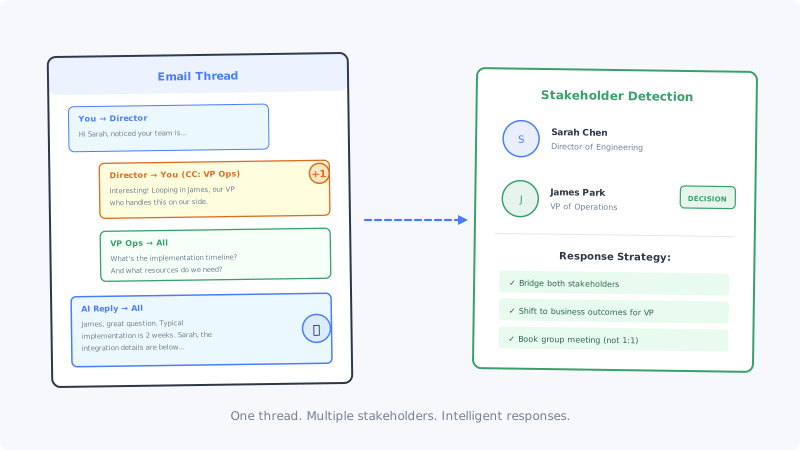
You send a cold email to a Director of Engineering. They reply with “Interesting, let me loop in our VP of Ops to see if this fits our current roadmap.” Suddenly your one-on-one thread has a new participant with different context, different priorities, and different questions.
This is the moment most AI reply agents fail. They were trained on single-threaded conversations. They know how to handle objections, answer feature questions, and book meetings with one person. But when the thread becomes a group conversation, the reply agent either ignores the new participant, addresses only the original contact, or generates a response so generic it satisfies nobody.
Multi-stakeholder threads are not edge cases. In B2B cold outreach, 30 to 40 percent of positive replies eventually involve a second person. The prospect loops in a colleague, CCs their manager, or forwards the thread to the actual decision-maker. If your AI reply agent cannot handle these transitions gracefully, you are losing deals at the exact moment they start gaining momentum.
Why Multi-Stakeholder Threads Are Different
A single-threaded conversation follows a predictable pattern: you pitch, they respond, you address their response, they ask a question, you answer. The AI reply agent maintains context by tracking the thread history and the single recipient’s persona.
Multi-stakeholder threads break this pattern in several ways.
Different people have different context. The original recipient has read your full email sequence. The person they CC’d has seen only the forwarded message and possibly a one-line internal comment. Your reply needs to provide enough context for the new participant without being redundant for the original one.
Authority dynamics shift. When a director CCs their VP, the decision-making power in the thread has moved up. Your reply agent needs to recognize that the new participant is likely the actual decision-maker and adjust tone and content accordingly. Continuing to pitch to the director as if they are the buyer loses credibility.
Questions become more specific. A director might ask “does this integrate with Salesforce?” A VP might ask “what is the implementation timeline and what resources do we need to commit?” The AI reply agent needs to recognize that the second question demands a different depth of answer.
The thread becomes a buying committee conversation. In enterprise sales, multiple stakeholders evaluating a solution is the norm, not the exception. The email thread becomes a micro-buying committee discussion, and your AI reply agent is a participant in that discussion.
Detecting Multi-Stakeholder Thread Changes
Before your AI reply agent can respond appropriately, it needs to detect that the thread has changed from single to multi-stakeholder. There are several signals to monitor.
New email addresses in CC or To fields. The most obvious signal. When a reply includes a new email address that was not in the original thread, the AI agent should flag the thread as multi-stakeholder and adjust its response strategy.
Forwarded message indicators. Some prospects forward your email to a colleague with a note like “Take a look at this.” The forwarded message may arrive as a new thread from a different sender, or the colleague may reply-all to the forwarded chain. Both patterns need to be detected.
Role changes in the reply. When the reply says “I am looping in [Name], our [Title]” or “Adding [Name] who handles this on our side,” the AI agent should extract the new participant’s name and role to inform its response.
Questions that do not match the original contact’s profile. If the original recipient is a marketing manager and the reply suddenly asks about API documentation and data security compliance, someone else is likely driving those questions. The AI agent should recognize the shift in question sophistication.
Response Strategies for Multi-Stakeholder Threads
Once the AI reply agent detects a multi-stakeholder thread, it needs a different response playbook.
Strategy 1: The Bridge Response
When a prospect introduces a colleague by name and role, the AI agent should acknowledge both participants.
Instead of replying only to the original question, structure the response to bridge between participants: “Great question from [New Participant]. Here is a quick overview for context, and [Original Contact], I have included the technical details you asked about below.”
This approach validates the new participant, provides them context without a separate thread, and maintains continuity with the original conversation.
Strategy 2: The Context Reset
When the thread is forwarded to someone new without your original context, the AI agent should provide a brief, non-redundant summary.
Do not re-paste your entire original cold email. Instead, lead with a two-sentence context line: “For context, we help [type of company] solve [specific problem]. [Original Contact] and I were discussing how this could apply to [their specific situation].”
Then address whatever the new participant asked or engage them with a relevant question based on their role.
Strategy 3: The Authority Shift
When the new participant is clearly more senior than the original contact, the AI agent should subtly shift its communication style.
For a VP or C-level addition, lead with business outcomes rather than features. Replace “our platform integrates with Salesforce in under 30 minutes” with “teams using our platform typically see [metric improvement] within the first quarter, and the implementation requires minimal engineering resources.” The technical details are still available but framed around the executive’s decision criteria.
Strategy 4: The Escalation Trigger
Some multi-stakeholder additions signal that the conversation has outgrown what an AI reply agent should handle. When a CFO, legal counsel, or procurement team member joins the thread, the AI agent should hand off to a human rep.
The handoff should be invisible to the prospect. The AI agent’s final message in the thread should naturally transition to the human rep: “I would love to set up a call so our team can walk through the specifics with everyone involved. [Rep Name] on our team specializes in [relevant area] and can address [specific question raised]. Does [time] work?”
Configuring Your AI Reply Agent for Multi-Stakeholder Scenarios
Setting up Underfive to handle multi-stakeholder threads requires configuring several components.
Participant tracking. Enable tracking of all email addresses in the thread. Each new participant should trigger a role-detection step where the AI agent checks the participant’s title and company against available data (LinkedIn, CRM, email signature parsing).
Response templates per role. Create response variations based on the new participant’s role: technical evaluator, financial decision-maker, end user, or unknown. The AI agent selects the appropriate template layer and blends it with the existing thread context.
Escalation rules. Define clear rules for when the AI agent should hand off to a human rep. Common triggers: C-suite additions, legal or procurement involvement, requests for custom pricing, or NDA/security questionnaire discussions.
Thread memory. The AI agent should maintain a summary of what has been discussed, what questions have been asked, and what commitments have been made. When a new participant asks a question that was already addressed earlier in the thread, the agent can reference the previous answer without repeating it verbatim: “As I mentioned to [Original Contact], our implementation timeline is typically [X]. Happy to go into more detail on the specific steps.”
Common Mistakes in Multi-Stakeholder Handling
Ignoring the new participant entirely. When a prospect CCs their colleague and the AI agent responds without acknowledging the new person, it signals that either the response is automated or the seller does not care about the new stakeholder. Both impressions are bad.
Over-explaining to the original contact. If the AI agent provides a full context reset in a reply-all, the original contact reads information they already know and feels like the conversation is going backward. Context resets should be directed at the new participant, not broadcast.
Using the same tone for everyone. A reply that is appropriate for an SDR-level contact reads as too casual for a VP. The AI agent should calibrate formality, detail level, and business framing based on the most senior person in the thread.
Failing to book the right meeting. When the conversation involves multiple stakeholders, the meeting invitation should include all relevant participants. An AI agent that sends a calendar link for a 1:1 when there are three people in the thread misses the opportunity to get everyone in the room.
Tools like Kali let you send calendar invites that include all relevant stakeholders, which is significantly more effective than asking each person to book separately.
Maintaining Thread Coherence Across Multiple Replies
Multi-stakeholder threads often generate rapid back-and-forth: the VP asks one question, the director asks another, and someone else chimes in with a scheduling comment. The AI reply agent needs to handle these overlapping replies without generating contradictory or repetitive responses.
Response batching. If multiple replies arrive within a short window (5 to 15 minutes), the AI agent should wait briefly and respond to all of them in a single message rather than firing off separate replies to each. This prevents the thread from becoming chaotic.
Conflict detection. If the director says “We need Salesforce integration” and the VP says “We are migrating off Salesforce next quarter,” the AI agent should not answer both statements independently. It should acknowledge the internal context and ask a clarifying question rather than providing contradictory answers.
Attribution in responses. When answering multiple questions from multiple people, attribute each answer: “[VP Name], regarding the timeline…” and “[Director Name], for the integration question…” This shows that the AI agent is tracking the conversation as a whole, not just responding to the last message.
Data Quality in Multi-Stakeholder Outreach
When new participants join a thread, validate their email addresses before adding them to your CRM or outreach sequences. The original contact’s email was already verified, but the CC’d colleague might use a different domain, an alias, or a role-based address like [email protected].
Run new participant emails through Scrubby to confirm deliverability before any follow-up sequences target them directly. Adding an invalid email to your system from a CC’d thread clutters your CRM and can generate bounces if you later include them in campaigns.
Measuring Multi-Stakeholder Thread Performance
Track these metrics separately from single-threaded conversations:
Multi-stakeholder detection rate. What percentage of threads that involve multiple people does your AI agent correctly identify? Manual review of a sample set tells you whether the detection logic is working.
Appropriate response rate. Of the multi-stakeholder threads detected, how often does the AI agent generate a response that correctly addresses all participants? This requires periodic human review, but it is the most important quality metric.
Escalation accuracy. When the AI agent escalates to a human rep, how often was that escalation necessary? Too many false escalations wastes rep time. Too few means the AI agent is handling conversations it should not be.
Meeting conversion in multi-stakeholder threads. Multi-stakeholder threads should convert to meetings at a higher rate than single-threaded conversations because they signal genuine buying interest. If they do not, your AI agent’s multi-stakeholder handling needs improvement.
Key Takeaways
Multi-stakeholder threads are not complications. They are acceleration signals. A prospect who loops in their team is doing internal selling for you. Your AI reply agent needs to support that momentum, not stumble over it.
Configure your AI agent to detect new participants, adjust its response based on roles and authority levels, provide context without redundancy, and escalate when the conversation outgrows automation.
The deals that involve multiple stakeholders are the deals most likely to close. Make sure your AI reply agent treats them that way.