How to Prioritize Cold Email Replies by Buying Intent Using AI Scoring
Your team sends 2,000 cold emails on Monday. By Wednesday, 120 replies are sitting in the inbox. Some are eager buyers ready to hop on a call. Others are polite “maybe later” brush-offs. A few are outright unsubscribe requests. And your SDRs are working through them in the order they arrived, which means a high-intent reply from a VP of Engineering might sit untouched for six hours while a rep drafts a careful response to someone who was never going to buy.
This is the reply prioritization problem, and it silently kills pipeline velocity at every outbound team that scales past a handful of reps.
The fix is not hiring more people. It is scoring every reply for buying intent the moment it arrives, then routing the highest-scoring replies to the front of the queue. AI makes this possible at a speed and consistency that no manual triage process can match.
Why Reply Prioritization Is a Pipeline Problem, Not an Inbox Problem
Most SDR managers think about reply handling as an operational task: clear the inbox, respond to everyone, move on. But when you look at the data, the order in which replies get handled has a measurable impact on conversion rates.
Research from multiple sales engagement platforms shows that responding to an interested prospect within five minutes makes you roughly 10x more likely to connect than waiting 30 minutes. That window shrinks further when you consider that your cold email is competing with every other message in the prospect’s inbox.
Here is what happens in a typical manual workflow:
- Replies arrive in chronological order.
- An SDR opens the oldest unread reply and responds.
- High-intent replies that arrived later sit in the queue.
- By the time the SDR reaches a “let’s talk this week” reply, the prospect has already moved on or cooled off.
The damage compounds over weeks. If your team consistently reaches hot replies 3 to 4 hours late, you are losing a meaningful percentage of your booked meetings to response lag. Not because your messaging was wrong or your ICP was off, but because you answered the wrong reply first.
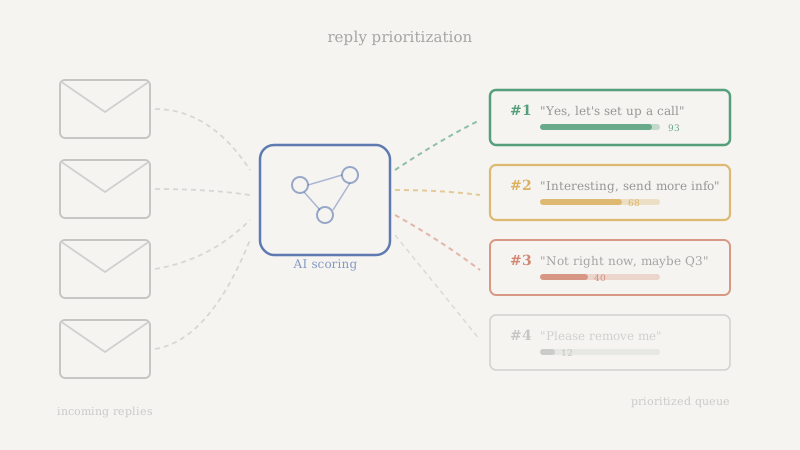
Prioritization by intent flips this. Instead of first-in-first-out, your reps work a queue sorted by likelihood to convert. The prospect who wrote “this sounds relevant, do you have time Thursday?” gets a reply in minutes. The prospect who wrote “send me more info” gets handled next. The unsubscribe request gets processed automatically.
What AI Intent Scoring Actually Measures
AI-powered intent scoring works by analyzing the text of each reply and assigning a numerical score based on signals that correlate with buying readiness. This is not keyword matching. Modern NLP models evaluate the full context of a reply, including tone, specificity, and implied next steps.
Here are the primary signals that scoring models evaluate:
Explicit Interest Language
The strongest signal is direct language indicating a desire to continue the conversation. Phrases like “let’s set up a call,” “can you send a proposal,” or “I’d like to learn more about pricing” score high because they map directly to pipeline progression. The model also catches variations and informal phrasing that keyword filters would miss, like “yeah this could work, shoot me some times” or “loop in my colleague who handles this.”
Urgency and Timing Cues
Replies that reference a specific timeline carry higher intent than open-ended interest. “We’re evaluating solutions this quarter” scores higher than “maybe sometime next year.” Mentions of upcoming renewals, budget cycles, or project deadlines all push the score upward. These temporal signals help your team understand not just whether a prospect is interested, but when they need to act.
Specificity of Questions
A prospect who asks generic questions (“what does your product do?”) is less engaged than one who asks specific, technical questions (“does this integrate with Salesforce?” or “how does pricing work for teams over 50?”). The scoring model weights specificity heavily because it indicates the prospect has already done some internal evaluation and is now in comparison mode.
Sentiment and Tone
The difference between “sure, send me something” and “this is exactly what we’ve been looking for” is enormous in terms of conversion probability. AI models trained on sales reply data can parse enthusiasm, skepticism, and neutrality with high accuracy. Negative sentiment (frustration with current tools, complaints about a competitor) can actually score high too, because it signals dissatisfaction that your product might solve.
Role and Authority Signals
Some scoring models cross-reference the reply against CRM data or enrichment tools to factor in the seniority of the person responding. A reply from a Director carries different weight than a reply from an intern, even if the text is identical. This layer of scoring helps teams focus on replies from people who can actually sign a check.
How the Scoring Pipeline Works in Practice
The mechanics of AI intent scoring follow a straightforward pipeline, but the speed is what makes it valuable.
Step 1: Reply ingestion. The moment a reply arrives, the system captures the full text along with metadata (sender, subject line, thread history, time of reply).
Step 2: Classification. The AI model classifies the reply into broad categories: positive interest, question or information request, objection, referral, out-of-office, or opt-out. This first pass filters out replies that require no human attention (auto-replies, unsubscribes) and routes them to automated handling.
Step 3: Intent scoring. For replies that pass the classification filter, the model assigns a numerical intent score (typically 0 to 100) based on the signals described above. This score represents the model’s confidence that this reply will lead to a booked meeting within the current outreach cycle.
Step 4: Queue reordering. The scored replies populate a prioritized queue that your SDRs work from. The highest-scoring replies appear at the top. Some teams set thresholds: anything above 80 triggers an immediate notification or even an automated first response, while replies scoring 40 to 79 enter the standard queue, and anything below 40 goes to a nurture track.
Step 5: Response. With Underfive, high-scoring replies can receive an AI-generated response within minutes of arrival, keeping the conversation warm while a human rep reviews and follows up. This eliminates the dead time between reply receipt and first response, which is where most pipeline leakage occurs.
The entire pipeline from ingestion to response takes less than five minutes. For a manual process, the equivalent workflow (read, evaluate, prioritize, draft, send) takes 15 to 45 minutes per reply, and that assumes the rep is available immediately.
Building Intent Scoring Into Your Outbound Stack
AI intent scoring does not exist in isolation. It works best when it connects to the other systems your team already uses.
CRM integration. Intent scores should flow into your CRM as a field on the contact or deal record. This gives AEs visibility into how engaged a prospect was before they entered the pipeline, and it helps RevOps teams build reports on which intent score ranges actually convert to closed-won revenue.
Email validation upstream. Scoring only matters if the replies you are analyzing come from real prospects. If your outbound lists contain invalid or disposable email addresses, you are wasting scoring capacity on bounced messages and fake replies. Running your lists through a validation tool like Scrubby before launch ensures that the replies hitting your scoring engine come from real, deliverable addresses.
Sequence and cadence tools. Intent scores can trigger different follow-up sequences. A reply scoring 85+ might skip the standard nurture sequence and go straight to a meeting-booking flow. A reply scoring 50 might enter a more educational drip. Connecting scores to your sequencing tool lets you automate the post-reply journey based on actual buying signals rather than arbitrary time delays.
Calendar and scheduling. For your hottest replies, the fastest path to a meeting is embedding scheduling directly into the response. Teams using tools like Kali for calendar-based outreach can connect intent scores to automated scheduling links, so a high-intent prospect gets a personalized booking page in their first response.
What Changes When You Score Every Reply
Teams that implement intent-based reply prioritization typically see three measurable shifts.
Response time for high-intent replies drops dramatically. Instead of an average 4 to 6 hour response time across all replies, high-intent replies get answered in under 10 minutes. This alone can increase meeting booking rates by 25 to 40 percent, based on data from teams running A/B tests on response speed.
Rep productivity increases without adding headcount. When SDRs work a prioritized queue, they spend less time on replies that were never going to convert and more time on conversations that matter. The cognitive load decreases too, because the scoring system has already done the triage work. Reps open their queue knowing the first reply they see is the most important one.
Pipeline quality improves. Deals that enter the pipeline from high-intent replies tend to have shorter sales cycles and higher close rates. By front-loading attention on the most engaged prospects, you are not just booking more meetings, you are booking better meetings. RevOps teams can use intent score data to refine ICP definitions and improve targeting over time.
Common Mistakes to Avoid
Intent scoring is powerful, but it is not a set-and-forget system. Here are the pitfalls that trip up teams during implementation.
Treating the score as a binary. A score of 72 is not the same as a score of 95, and your workflow should reflect that. Avoid collapsing scores into just “hot” and “cold.” Use at least three tiers (high, medium, low) with distinct response workflows for each.
Ignoring medium-intent replies. It is tempting to pour all resources into the top-scoring replies and neglect the middle of the distribution. But medium-intent replies (the “send me more info” and “interesting, tell me more” responses) represent a large portion of your eventual pipeline. They need timely, thoughtful responses too, just not at the same urgency as a “let’s meet Thursday” reply.
Not calibrating the model to your domain. Generic intent scoring works reasonably well out of the box, but it improves significantly when trained on your specific reply data. If your product sells to a technical audience, the model needs to learn that “does this support SSO?” is a high-intent question, not a casual inquiry. Feed your scored and converted reply data back into the system regularly.
Skipping the human review loop. AI scoring is a prioritization tool, not a replacement for human judgment. Your reps should still review and refine responses, especially for high-value accounts. The AI handles the triage and first-draft response; the human adds the strategic nuance.
Where This Fits in the Future of Outbound
Reply prioritization by intent is one piece of a broader shift in how outbound sales operates. The teams that will win over the next few years are the ones that treat every stage of the outbound funnel, from list building and validation to initial outreach, reply handling, and meeting booking, as an interconnected system rather than a set of disconnected tools.
AI scoring at the reply stage connects naturally to AI-generated initial sequences, validated contact data, and automated scheduling. Platforms like Underfive sit at the reply handling layer, using intent signals to respond faster and smarter than any manual process can. Combined with clean data from validation tools and intelligent scheduling, the result is an outbound engine that runs with fewer manual bottlenecks and higher conversion at every step.
The SDR teams that adopt intent-based prioritization now will have a compounding advantage. Every week of faster, smarter reply handling means more meetings booked, more pipeline generated, and more data to feed back into the scoring model. The teams that wait will keep losing winnable deals to response lag, one stale inbox at a time.