How AI Reply Agents Handle Multi-Thread Conversations Without Losing Context
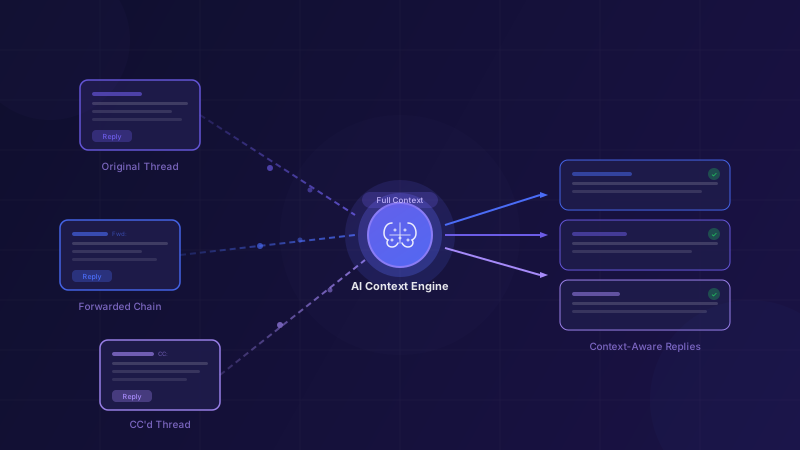
Cold email is not a single-thread medium. You send a sequence to a VP of Engineering. She forwards it to her colleague in procurement with a note: “Is this worth looking at?” Procurement replies to you from the forwarded chain. Meanwhile, the VP also replies directly to your original email two days later with a separate question. A week after that, her EA CCs you on a new thread asking about scheduling.
That is three threads, three different people, one deal. And if your reply system treats each thread as an independent conversation, you are going to send conflicting information, ask questions that have already been answered, or worse — ignore a thread entirely because your system didn’t connect it to the original outreach.
This is the multi-thread problem, and it is one of the hardest challenges in cold email automation. It is also the reason most AI reply tools produce responses that feel disjointed and robotic the moment a conversation gets even slightly complex.
Why Multi-Thread Conversations Happen
Before getting into solutions, it helps to understand why prospects don’t just reply neatly to your original email. The reasons are structural, not behavioral.
Forwarding for Internal Buy-In
Enterprise purchases rarely involve a single decision-maker. When your cold email lands with the right person, their first instinct is often to forward it to someone else — a technical lead, a budget holder, a colleague who mentioned a similar problem last week. That forward creates a new thread. When the recipient of that forward replies to you, they are starting a conversation you didn’t initiate, with context you didn’t provide.
CC Expansion
A prospect replies to your email and CCs their manager or a colleague. Now the conversation has multiple participants, and any of them might reply independently. The manager might reply-all with a question. The colleague might reply just to you with a separate concern. Each of these responses carries different context and intent.
Thread Breaks from Mobile and Different Clients
Email clients handle threading differently. A prospect who reads your email on their phone and replies might create a new thread because their mobile client didn’t preserve the message-ID chain. Outlook, Gmail, and Apple Mail all have slightly different threading behaviors. A reply that should be part of an existing conversation shows up as a brand-new email.
Delayed Responses Across Sequence Steps
You send a three-step sequence. The prospect ignores step one, then replies to step two asking a question. Before you respond, they also reply to step three with “I already asked about this.” Now you have two active threads referencing different emails in the same sequence, and the prospect is already annoyed at the redundancy.
How Context Gets Lost
When an AI reply agent treats each incoming email as a standalone event, the failures are predictable and damaging.
Redundant questions. The prospect told your AI their team size in one thread. In a parallel thread, the AI asks again. The prospect now thinks they are talking to a system that doesn’t listen.
Contradictory responses. In thread A, your AI suggests a particular plan tier. In thread B, initiated by a forwarded chain, the AI recommends a different tier because it doesn’t have the context from thread A. The prospect compares notes with their colleague and your credibility evaporates.
Missed buying signals. The procurement person in the forwarded thread asks about contract terms — a strong buying signal. But because your system doesn’t connect that thread to the original outreach, it treats it as a cold inbound and responds with top-of-funnel messaging. The moment is wasted.
Dropped threads entirely. Some reply tools only monitor the original thread. If a prospect replies from a forwarded chain or a new thread, the message sits in an inbox with no automation watching it. By the time a human notices, the prospect has moved on.
The core issue is identity resolution across threads. Knowing that the email from [email protected] replying to a forwarded version of your outreach to [email protected] is part of the same deal — and that both threads need to inform every future response — is a problem that requires more than simple email parsing.
How Underfive Tracks Multi-Thread Conversations
Underfive was built with multi-thread awareness as a core architectural decision, not a feature added later. Here is how it works in practice.
Thread Graph Construction
When Underfive processes an incoming reply, it doesn’t just look at the email it’s responding to. It builds a graph of related threads by analyzing message-ID headers, in-reply-to references, email addresses involved, domain associations, and temporal proximity to active sequences. If a new email comes in from someone at the same company you’re actively engaging, Underfive checks whether it’s connected to an existing conversation — even if the email headers don’t explicitly link them.
Unified Conversation Context
Every thread connected to a deal feeds into a single context window. When Underfive drafts a reply to the procurement person in the forwarded chain, it has access to everything the VP said in the original thread, every question that’s been asked and answered across all threads, and every commitment or detail that’s been shared. The response is consistent because the context is complete.
Participant Awareness
Underfive tracks not just threads but participants. It knows that the person replying from the forwarded chain is a different individual than the original prospect. It adjusts tone, detail level, and content based on who it’s talking to — while maintaining consistency on facts, pricing, and positioning across all participants in the deal.
Sequence Intelligence
When a prospect replies to step two of your sequence while step three is scheduled, Underfive doesn’t just pause the sequence. It reconciles the reply against all pending and sent messages, ensures no redundant follow-ups go out, and factors the reply content into any future responses — regardless of which thread they occur in.
Multi-Thread Scenarios in Practice
These are real patterns that occur in outbound sales, and how a context-aware AI reply agent handles each one.
Scenario 1: The Forward-and-Reply
You email a Director of Operations. She forwards your email to her team lead with “thoughts?” The team lead replies to you: “What integrations do you support?”
Without multi-thread awareness: Your AI responds to the team lead with a generic intro pitch because it treats this as a new cold inbound. It has no idea this person is connected to an active deal.
With Underfive: The AI recognizes the team lead’s reply is connected to the Director’s outreach thread. It responds to the integration question directly, references the Director’s role to signal it understands the internal dynamic, and keeps the tone appropriate for someone evaluating on behalf of a decision-maker.
Scenario 2: The CC Expansion
A prospect replies to your email and CCs their CFO: “Looping in [name] since this touches budget.” The CFO replies separately with: “What’s the annual commitment?”
Without multi-thread awareness: The AI responds to the CFO’s pricing question without context about what’s already been discussed with the original prospect. It might quote list pricing when the original thread had already discussed a custom arrangement.
With Underfive: The AI sees that the CFO’s thread is linked to the original prospect’s conversation. It answers the pricing question consistently with whatever has been discussed, and it understands that a CFO asking about annual commitment is a late-stage buying signal that warrants a direct, specific answer — not a redirect to “book a call.”
Scenario 3: The Thread Break
A prospect replies to your email from their phone. Their email client creates a new thread. They ask: “Can you send me the case study you mentioned?”
Without multi-thread awareness: Your system doesn’t connect this new thread to the original conversation. If it responds at all, it doesn’t know which case study was mentioned because that context lives in a different thread.
With Underfive: The AI matches the sender and domain to the active conversation, pulls in the context from the original thread, identifies which case study was referenced, and sends it. The prospect gets exactly what they asked for without having to repeat themselves.
Scenario 4: The Multi-Step Sequence Collision
You’re running a four-step sequence. The prospect replies to step two with interest. Before your AI responds, step three fires. The prospect replies to step three: “I already responded to your last email.”
Without multi-thread awareness: Your AI responds to both threads independently. The prospect gets two different responses and feels like they’re being spammed by a bot.
With Underfive: The AI holds the step-three thread, recognizes the prospect already engaged on step two, sends a single coherent response that acknowledges both messages, and suppresses any remaining sequence steps.
The Impact on Conversion
Multi-thread handling is not a nice-to-have feature. It directly affects whether deals progress or stall.
Response consistency builds trust. When a prospect checks with a colleague and both received coherent, aligned information from your outreach, your credibility increases. When the information conflicts, the deal is effectively dead.
Speed across all threads matters. A prospect who replies from a forwarded chain expects the same response speed as a direct reply. If your system only monitors original threads, forwarded replies sit unanswered for hours or days. Underfive responds across all connected threads within minutes, not just the ones your sequence tool is watching.
Participant-aware responses feel human. When your AI adjusts its communication style based on whether it’s talking to the original prospect, their colleague, or their manager — while keeping facts consistent — the entire interaction feels like it’s being handled by a competent salesperson, not a bot.
No dropped threads means no dropped deals. The most expensive failure in outbound is not a bad reply — it’s a missed reply. A prospect who took the time to respond and got nothing back will not respond again. Multi-thread tracking ensures every reply, regardless of which thread it arrives in, gets a timely and contextual response.
What to Look For in a Multi-Thread Capable Reply Agent
If you’re evaluating AI reply tools, here are the specific capabilities that separate thread-aware systems from thread-blind ones.
Cross-thread identity resolution. Can the system connect emails from different people at the same company to a single deal? Can it handle forwarded chains where the original sender is not the person replying?
Unified context across threads. When the AI responds in one thread, does it have access to information shared in all related threads? Or does each thread operate in isolation?
Sequence reconciliation. When a reply comes in on one thread, does the system pause or adjust messages scheduled in other threads? Or do sequence steps fire regardless of engagement in parallel threads?
Participant differentiation. Does the AI know who it’s talking to within a multi-person conversation? Does it adjust its responses based on the recipient’s role and relationship to the deal?
Thread detection beyond headers. Does the system rely solely on email headers for threading, or can it infer connections based on domain, timing, and content? Header-based threading alone misses a significant portion of multi-thread scenarios.
Moving Past Single-Thread Thinking
The cold email industry has spent years optimizing single-thread metrics: open rates, reply rates, response times. These metrics matter, but they describe a world where one email goes to one person and one reply comes back in the same thread. That is not how enterprise sales works.
Real deals involve multiple people, multiple threads, and conversations that branch and merge unpredictably. An AI reply agent that can only handle linear, single-thread conversations is solving last year’s problem.
Underfive was built for how cold email actually works — messy, multi-threaded, and multi-participant. Every reply, from every thread, from every person connected to a deal, gets a response that reflects the full context of the conversation. Nothing gets lost. Nothing gets contradicted. No thread gets dropped.
That is what it takes to convert cold email replies into pipeline at scale.