How AI Reply Agents Handle Negative Replies and Turn Rejections Into Future Pipeline
A prospect replies to your cold email. Your AI reply agent fires up, ready to continue the conversation. But the reply is not “tell me more.” It is “not interested,” “remove me from your list,” “we already use a competitor,” or something significantly less polite.
This is the moment most outbound operations fumble. Manual SDR teams take hours to respond, if they respond at all. Automated sequences blindly send the next follow-up as if the rejection never happened. Both approaches destroy the relationship permanently.
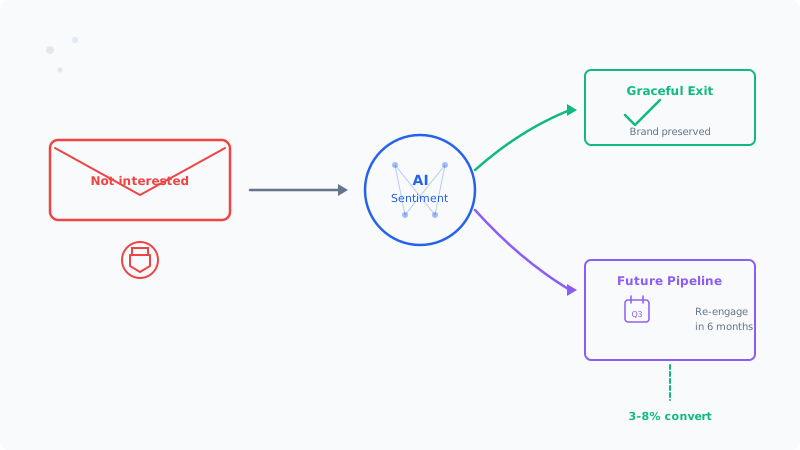
AI reply agents handle this differently. When trained properly, they detect negative sentiment in real time, choose the appropriate response strategy, and preserve the relationship for future engagement. A “no” today does not have to mean “never.” But only if the rejection is handled correctly in the first five minutes.
The Anatomy of a Negative Reply
Not all negative replies are the same, and treating them identically is one of the most common mistakes in cold email operations. A well-configured AI reply agent categorizes negative responses into distinct types, each requiring a different response strategy.
Hard Rejections
“Not interested.” “Do not contact me again.” “Unsubscribe.”
These are definitive. The prospect has made a clear decision. No amount of clever follow-up will change their mind, and attempting to do so crosses into spam territory.
The correct AI response: acknowledge the request, confirm removal from active sequences, and close the loop professionally. Something like: “Understood, I have removed you from our outreach. If anything changes down the line, we are easy to find.”
This response does three things. It respects the boundary. It confirms the action was taken. And it leaves a door open without being pushy. The prospect walks away with a neutral-to-positive impression of your brand instead of the frustration that comes from being ignored or argued with.
Soft Rejections
“Not right now.” “We just signed a contract with another vendor.” “Maybe next quarter.” “Timing is off.”
These are not rejections. They are deferrals. The prospect is telling you they have interest but the conditions are wrong today. This is valuable intelligence that most outbound teams waste.
A properly trained AI reply agent recognizes deferral language and responds with a specific follow-up commitment: “Makes sense. Would it be helpful if I reached back out in Q3 when your current contract is up for review?”
This converts a rejection into a scheduled pipeline opportunity. The prospect has effectively told you when to re-engage and what trigger to watch for. Your AI agent captures that data, sets a reminder, and the prospect re-enters your pipeline at exactly the right moment.
Competitor Mentions
“We use [Competitor X].” “We are happy with our current solution.” “Already covered.”
Competitor mentions are some of the most valuable negative replies you can receive. The prospect has confirmed they are in your market. They have budget. They have a defined need. The only problem is that someone else is filling it right now.
The AI reply agent’s job here is not to trash the competitor. It is to plant a seed and establish a reference point for when dissatisfaction inevitably arrives. A strong response: “Good choice, they are solid for [specific use case]. We hear from a lot of teams who switch to us when they hit [specific limitation]. Happy to share what that looks like if it ever comes up.”
This positions your product as the natural next step without being adversarial. When the prospect does hit that limitation (and most eventually do), your brand is already in their mind as the alternative.
Hostile Replies
Angry responses, profanity, accusations of spam. These happen. They are unpleasant but they are also the easiest to handle correctly.
The AI reply agent’s response is simple: apologize, remove, and exit. “I apologize for the interruption. I have removed your address from all future outreach. Wishing you well.” No defensiveness. No explanation. No attempt to continue the conversation. Hostile replies are about the prospect’s emotional state, not your product. The only winning move is to respect it and disappear.
How the AI Detects Sentiment
Modern AI reply agents, like the inbox agents inside Underfive’s Unified Inbox, use natural language understanding to classify incoming replies along multiple dimensions before generating a response.
Explicit signals: keywords like “not interested,” “remove me,” “unsubscribe,” and “stop emailing” are straightforward to detect. Any competent AI model catches these immediately.
Implicit signals: tone, word choice, and sentence structure convey sentiment even without explicit rejection words. “Thanks but we are all set” is a soft rejection. “Who gave you my email?” is hostile. “Interesting but we just renewed” is a deferral with a timing signal. The AI evaluates these contextual cues to determine the appropriate response category.
Context signals: the AI considers the full thread history. If the prospect engaged positively in earlier replies and then sends a brief “pass,” the context suggests a change in circumstances rather than fundamental disinterest. That changes the response strategy from closure to re-engagement.
Building the Re-Engagement Pipeline
The real value of handling negative replies well is what happens six months later. Every properly handled rejection is a data point in your future pipeline.
The Rejection Database
Track every categorized rejection with:
- Prospect name and account
- Rejection type (hard, soft, competitor, hostile)
- Specific reason given (if any)
- Suggested re-engagement timing (if deferral)
- Competitor mentioned (if any)
This database becomes one of your most valuable outbound assets. It tells you exactly which accounts to revisit, when to revisit them, and what angle to use.
Trigger-Based Re-Engagement
When a prospect said “we just signed with [Competitor X],” you now have a defined trigger: their contract renewal window. Most B2B contracts run 12 months. Set a re-engagement sequence to fire at month 10.
When a prospect said “not right now, maybe Q3,” you have an explicit timing signal. Queue the re-engagement for early Q3 with a message that references the original conversation: “You mentioned Q3 might be better timing. Is now a good moment to revisit?”
For teams using Kali alongside email outreach, consider re-engaging these deferred prospects through calendar invites instead of email. The prospect already rejected your email approach. A calendar invite through a different channel may break through where another email would not.
Measuring Rejection-to-Pipeline Conversion
Track the percentage of rejected prospects who eventually convert to meetings or opportunities after re-engagement. For well-managed rejection pipelines, this conversion rate typically ranges from 3 to 8% over a 12-month period.
That number sounds small until you multiply it by volume. If your AI reply agent processes 500 negative replies per month and 5% convert to meetings within a year, that is 25 additional meetings per month generated from prospects who originally said no. At typical B2B deal sizes, this can represent significant pipeline that would have been abandoned entirely without proper rejection handling.
The Response Time Advantage
Speed matters as much with negative replies as it does with positive ones. A prospect who says “not interested” at 2 PM and receives a graceful acknowledgment within 60 seconds has a fundamentally different experience than one who gets ignored for 24 hours and then receives a tone-deaf follow-up.
The AI reply agent’s ability to respond in under a minute to negative replies creates three advantages:
- The prospect feels heard. Immediate acknowledgment shows your organization is responsive, even when the answer is no.
- The interaction closes cleanly. No lingering open loop where the prospect wonders if you received their rejection.
- Brand perception stays positive. The speed and professionalism of the response becomes the lasting impression, not the unwanted email that started the conversation.
Manual SDR teams cannot match this speed on negative replies because those replies get deprioritized. When an SDR sees “not interested” in their inbox, it goes to the bottom of the stack behind active deals and positive responses. The AI agent treats every reply with the same urgency.
Training Your AI Agent for Rejection Handling
The default behavior of most AI reply agents is to continue the conversation. You need to explicitly train override behaviors for negative sentiment categories.
Define Exit Criteria
Specify exactly which types of responses should trigger conversation closure versus continued engagement. Hard rejections and hostile replies should always exit. Soft rejections and competitor mentions should trigger a specific response strategy, not a generic follow-up.
Build Response Templates by Category
Create approved response frameworks for each rejection type. The AI agent should not improvise when handling sensitive negative replies. Give it specific language patterns that have been reviewed by your sales leadership for tone and compliance.
Set Suppression Rules
When the AI agent detects a hard rejection, it should automatically suppress the prospect from all active sequences, not just the current one. A prospect who says “stop emailing me” and then receives a different sequence from the same company three days later will report you as spam. Ensure cross-sequence suppression is configured.
Review and Refine Weekly
Pull a sample of negative reply conversations weekly. Check whether the AI correctly categorized the sentiment, chose the right response strategy, and handled the interaction professionally. Use misclassifications to retrain the model and tighten response quality.
Conclusion
Negative replies are not the end of the conversation. They are data, intelligence, and future pipeline disguised as rejection. AI reply agents that handle “no” with speed, accuracy, and grace convert a cost center (wasted outreach) into a pipeline asset (informed re-engagement).
The teams that win at outbound are not the ones that avoid rejection. They are the ones that handle it so well the prospect remembers them positively when circumstances change.