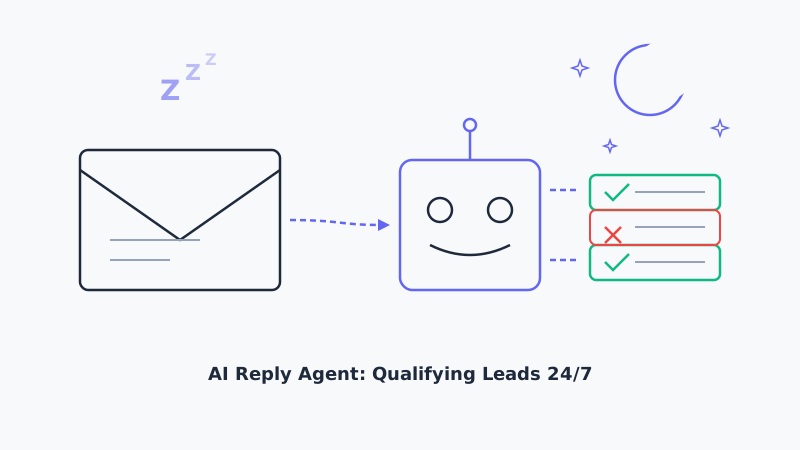
The Problem With Inbound Lead Response Times
Here’s a stat that should keep every sales leader up at night: responding to a lead within five minutes makes you 21x more likely to qualify them compared to waiting 30 minutes. Yet the average B2B company takes over 42 hours to respond to an inbound inquiry.
Think about what happens when someone fills out your contact form at 11pm on a Tuesday. They’re interested right now. They’re comparing vendors right now. By the time your SDR gets to it the next morning, that prospect has already talked to two competitors, read three blog posts, and possibly made a decision.
AI reply agents solve this by responding instantly, at any hour, with intelligent qualification questions that feel natural and human.
What Actually Qualifies a Lead?
Before we talk about how AI handles qualification, let’s ground ourselves in what “qualified” means. Most teams use some variation of BANT (Budget, Authority, Need, Timeline) or MEDDIC, but the core questions are usually:
- Does this person have a problem we solve?
- Can they make or influence the buying decision?
- Is there urgency or a timeline driving action?
- Does their company fit our ICP (industry, size, revenue)?
Traditional qualification requires a human to ask these questions on a call or in a back-and-forth email thread. An AI reply agent compresses this process into a natural conversation that happens in minutes rather than days.
How AI Agents Parse Intent From Replies
Modern AI reply agents don’t just pattern-match keywords. They understand context, urgency signals, and conversational nuance. Here’s what that looks like in practice.
Signal Detection
When a prospect replies to your outreach or submits a form, the AI agent analyzes several layers:
Explicit signals: Direct statements like “We’re looking for a solution by Q3” or “Our current tool isn’t working” give clear qualification data.
Implicit signals: The tone, specificity, and questions a prospect asks reveal intent. Someone asking “How does your pricing work for teams of 50?” is much further along than someone asking “What do you do?”
Behavioral signals: Reply speed, message length, and follow-up frequency all indicate engagement level. A prospect who responds within minutes with detailed questions is showing high intent.
Natural Conversation Flow
The best AI reply agents don’t fire off a rigid list of qualification questions. Instead, they weave qualifying questions into a natural dialogue. For example:
A prospect writes: “Hey, saw your product. We’re struggling with lead follow-up and losing deals because we’re too slow.”
A good AI agent might respond: “That’s a common challenge, and speed really does make the difference. Just so I can point you to the right resources, how large is your sales team currently, and are you primarily handling inbound or outbound leads?”
That single response acknowledges the pain, builds rapport, and asks two qualifying questions without feeling like an interrogation.
Platforms like Underfive have built the inbox agents inside their Unified Inbox specifically for this kind of conversational qualification, where the goal is to keep the exchange feeling human while extracting the data your sales team needs.
Routing Qualified Leads to Sales Reps
Qualification is only half the equation. The other half is getting the right lead to the right rep at the right time. Here’s how AI agents handle routing:
Scoring in Real-Time
As the AI agent converses with a prospect, it builds a qualification score based on responses. Once a threshold is met (say, confirmed budget + authority + timeline), the lead gets flagged as sales-ready.
Smart Assignment
Qualified leads can be routed based on:
- Territory: Geographic or industry-based assignment
- Specialization: Product line or use case expertise
- Availability: Round-robin with capacity awareness
- Deal size: Enterprise leads to senior reps, SMB to dedicated teams
Warm Handoff
The best part of AI qualification is the handoff. Instead of a cold CRM entry, your rep gets a conversation summary: “This is Sarah from Acme Corp (200 employees, SaaS, Series B). She’s the VP of Sales, currently using Competitor X, unhappy with their reporting. Looking to switch within 60 days. Budget approved.”
Your rep walks into that first call already knowing everything they need. No discovery call needed; they can jump straight to a demo tailored to Sarah’s pain points.
Handling Off-Hours Responses
This is where AI reply agents really shine. Consider the math:
- A standard sales team works roughly 8 hours per day, 5 days per week
- That leaves 128 hours per week where nobody is responding
- For global teams, time zones make this even worse
AI agents operate 24/7/365. A prospect in Tokyo who responds at 2am Eastern gets the same thoughtful, qualifying response as someone who replies at 10am. No delays, no “I’ll get back to you tomorrow.”
Weekend and Holiday Coverage
Weekends and holidays are actually prime engagement windows. People have time to research, compare, and respond. If your AI agent is active while competitors are dark, you’re capturing opportunities others miss entirely.
Managing Expectations
Smart AI agents also set proper expectations during off-hours. If a lead qualifies at 3am and needs a human conversation, the agent can say: “Great, based on what you’ve shared, I think a quick call with our team would be really valuable. I’ll have someone reach out first thing tomorrow morning. In the meantime, would it be helpful if I sent over a brief case study from a company similar to yours?”
This keeps the momentum alive without over-promising immediate human availability.
Measuring Qualification Accuracy
If you’re going to trust an AI agent with your inbound pipeline, you need to measure how well it’s doing. Here are the key metrics to track:
Qualification Accuracy Rate
Compare AI-qualified leads against actual outcomes. If the agent marks a lead as “sales-ready,” does that lead actually convert at a higher rate than unqualified leads? You should see at least a 60-70% accuracy rate for the system to be valuable.
False Positive Rate
How often does the AI flag a lead as qualified when they’re actually not ready? High false positives waste rep time and erode trust in the system. Keep this under 20%.
False Negative Rate
Conversely, how many good leads does the AI incorrectly dismiss or fail to escalate? This is often the more dangerous metric because you never see the deals you missed. Periodic manual review of “disqualified” conversations helps catch this.
Speed to Qualification
Track how quickly the AI agent moves a lead from first touch to qualified status. The best agents achieve full qualification in 2-3 message exchanges, usually within 24 hours of first contact.
Conversation Quality Scores
Have your team periodically review AI conversations for tone, accuracy, and naturalness. The goal is that a prospect shouldn’t realize they’re talking to an AI until the human handoff (if they realize at all).
Building Your AI Qualification Playbook
Ready to implement AI lead qualification? Here’s a practical framework:
Step 1: Define Your Qualification Criteria
Write down exactly what makes a lead qualified for your team. Be specific. “Has budget” is vague. “Has confirmed budget of $5K+ per month with decision-making authority” is actionable.
Step 2: Map Your Conversation Flows
Outline the key paths a conversation might take. What if someone is qualified but not ready to buy yet? What if they’re ready but not the decision-maker? Each scenario needs a defined next step.
Step 3: Set Up Your Scoring Model
Assign point values to different qualification signals. A confirmed timeline might be worth 30 points, while a matching industry is worth 10. Set thresholds for “qualified,” “nurture,” and “disqualify.”
Step 4: Integrate With Your Stack
Your AI agent needs to connect with your CRM, calendar tools, and communication platforms. Make sure qualified leads flow seamlessly into your existing workflow. If your outreach strategy includes tools like Kali for calendar-based outreach, the handoff from AI qualification to booked meeting should be frictionless.
Step 5: Monitor and Iterate
No AI system is perfect on day one. Review conversations weekly, adjust scoring thresholds, and refine conversation flows based on what you learn. The best teams treat their AI qualification system as a living process, not a set-and-forget tool.
The Data Hygiene Factor
One often-overlooked aspect of AI lead qualification is data quality. Your AI agent can only be as good as the data it’s working with. If inbound leads come in with invalid email addresses or fake contact information, your agent wastes cycles on dead-end conversations.
This is where email validation becomes critical. Tools like Scrubby help ensure that the leads entering your system are real people with valid contact information. When you pair clean data with intelligent AI qualification, your conversion rates improve dramatically because every conversation your agent has is with an actual potential buyer.
What the Future Looks Like
AI reply agents are evolving rapidly. The next generation will:
- Predict qualification likelihood before the first response based on firmographic data
- Adapt conversation style to match prospect communication preferences
- Coordinate multi-channel qualification across email, chat, and social
- Learn from closed-won deals to refine scoring models automatically
The teams that adopt AI qualification now are building a compounding advantage. Every conversation trains the system. Every closed deal refines the model. Six months from now, early adopters will have AI agents that qualify leads with near-human accuracy at machine speed.
Getting Started Today
You don’t need a massive budget or a six-month implementation timeline to start qualifying leads with AI. The simplest starting point is handling your after-hours inbound responses. Set up an AI agent to engage with leads that come in outside business hours, qualify them with 2-3 questions, and queue up the best ones for your team the next morning.
Once you see the results (faster response times, higher qualification rates, reps spending more time selling and less time sorting), expanding to full-time AI qualification becomes an easy decision.
Your leads aren’t waiting for you. They’re making decisions right now, at midnight, on weekends, during your team’s lunch break. The question isn’t whether to use AI for lead qualification. It’s how quickly you can get started.