
Prospect Replied Then Went Silent: How to Follow Up and Re-Engage a Warm Lead
A prospect replied then went silent, and it stings more than never hearing back at all. They said “sounds interesting,” or asked what it costs, or told you to send more details, and then the thread just stopped. You did the hard part. The list worked, the copy earned a response, a real person engaged, and now you are staring at a dead conversation wondering what you did wrong.
Usually the answer is nothing. An engaged prospect who goes quiet is not the same as a cold contact who ignored you, and treating the two the same way is why so many of these leads get written off. This post is about the specific case where someone replied, showed interest, and then ghosted, and how to follow up in a way that actually reopens the thread instead of burning it.
When a prospect replied then went silent, it is not the same as no reply
Most advice about following up assumes you got nothing back. Send touch two, touch three, touch four, keep going until they respond or opt out. That playbook is built for cold contacts who never raised their hand.
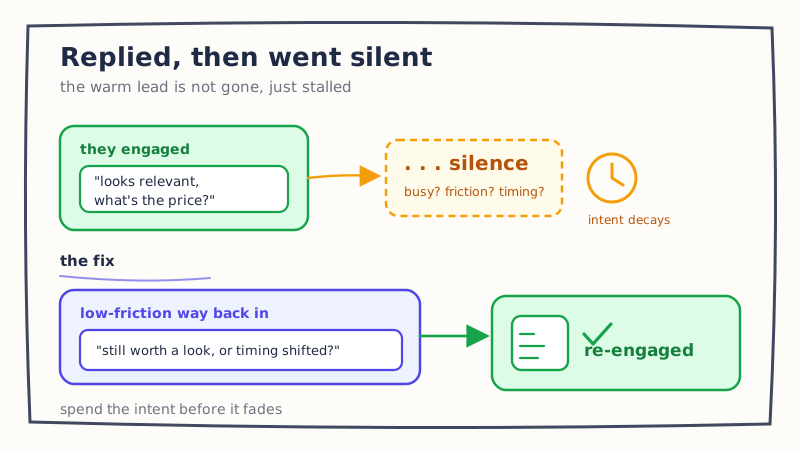
A prospect who replied and then went silent is a different situation entirely, and it is a better one. They have already told you the offer is relevant. They have given you context, a name, sometimes a title or a timeline. The intent was real. What decayed was not their interest in the problem, it was the momentum of the conversation. Your job is not to re-pitch a stranger. It is to spend the intent that already exists before it fades completely.
That distinction changes everything about how you follow up. You are not proving relevance again. You are removing whatever friction stalled the thread and making it effortless to pick back up.
Why engaged prospects go quiet
Before you can re-engage a silent prospect, you have to diagnose why they stopped. Engaged prospects go quiet for four common reasons, and each one calls for a different follow-up.
1. They got busy and the thread fell down the inbox
This is the most common reason by far, and the least dramatic. Your reply landed during a meeting, or a fire drill, or a Friday afternoon, and by the time they surfaced it was buried under forty newer emails. There is no rejection here, just gravity. The conversation did not end, it got physically lost.
2. Your reply added friction at the wrong moment
If you answered “interested” with a bare calendar link and a “grab a time,” you handed a warm human moment a chore. Same if you replied with a wall of text, a pricing PDF, and three questions. Interest is highest right after they reply, and the fastest way to kill it is to make the next step feel like work. A prospect who goes silent right after your response, rather than after theirs, is often telling you the friction was on your side.
3. They lost internal buy-in or shifted priorities
Sometimes the prospect was genuinely interested but could not carry it forward. A budget froze, a reorg happened, a bigger project ate the quarter, or the person they needed to convince said not now. They are not ghosting you personally. The internal case stalled, and mentioning it to you felt awkward, so they said nothing.
4. You were slow, and the window closed
Interest has a shelf life measured in hours, not days. If a prospect asked a question on Monday morning and you answered Wednesday afternoon, the version of them that was curious is gone. They have moved on to the next thing, and your late reply reads as background noise. We broke down why the clock matters this much in how five-minute response times increase conversions, and it applies double to a thread that was already live.
How to follow up after a prospect goes silent
Once you know the likely reason, the follow-up writes itself. Here is a framework that works across all four cases, with specific examples you can adapt.
Lead with a low-friction re-entry, not a re-pitch
The single most effective move is to make responding take five seconds. Do not recap your whole value proposition. Reference the exact thing they said and give them an easy on-ramp back in.
If they went quiet after showing interest:
“Hey Sarah, you mentioned this looked relevant for your Q4 outbound. Still worth a quick look, or has the timing shifted? Either answer is genuinely useful to me.”
That last line matters. Giving explicit permission to say “not now” lowers the cost of replying, which is exactly what a busy or stalled prospect needs. Counterintuitively, offering the easy out gets you more replies, not fewer.
Remove the friction that stalled the thread
If you suspect your own reply caused the silence, fix it directly in the follow-up. Replaced a calendar link with a concrete offer:
“I realize I threw a scheduling link at you, which is a bit much. Would Tuesday at 2pm or Thursday at 10am work for a 15-minute call? I will send the invite either way.”
Two specific times beat an open link every time. They remove decision fatigue and let the prospect say yes in one line. If your first reply was a wall of text, your follow-up should be three sentences.
Give them cover to reopen a stalled internal case
For the prospect whose priorities shifted, do not push. Offer a reason to keep you warm without committing:
“Totally understand if this dropped off the priority list. Want me to check back in a few weeks, or send over a one-pager you can forward internally when the timing is better?”
This respects that the block is on their side and hands them a tool, the forwardable one-pager, that helps them make your case when they are ready. A deferred yes is not a no, and the mistake most teams make is treating it like one. We covered that timing signal in depth in how AI reply agents handle “not right now, circle back later” replies.
Get the timing and the count right
Follow-up cadence for a warm-then-silent thread is tighter than for a cold sequence. The intent is fresher, so move faster, but do not stack messages.
- First follow-up: within 24 to 48 hours of the silence, while the thread is still recent.
- Second follow-up: 3 to 5 days later, with a new angle or a genuinely useful resource, not “just bumping this.”
- Final touch: about a week after that, a short, no-pressure close that leaves the door open. “I will stop cluttering your inbox. If outbound reply handling moves up the list, I am one email away.”
Two to three well-timed, varied touches recover most recoverable threads. Beyond that you are into diminishing returns and mild irritation. Know when to stop, and stop cleanly.
Why consistency is the real problem
Every technique above is simple. Doing it reliably, across every silent thread, on the right day, for months, is where teams fall apart. A rep handling replies between calls will catch the loud threads and miss the quiet ones. The prospect who went silent does not send a notification. Nobody is reminded to follow up on Thursday, so Thursday passes, and a recoverable lead quietly dies.
This is exactly the gap an AI reply agent is built to close. It watches every thread, notices when an engaged prospect goes quiet, and fires a context-aware follow-up at the right interval without a human remembering to. It reads what the prospect actually said, matches the follow-up to the reason for the silence, and keeps the cadence tight enough to catch fresh intent. The result is that “replied then went silent” stops being a leak and becomes a recovered conversation.
If you want the same discipline applied to threads that went cold long ago, not just fresh silences, that is the sister problem we covered in rescuing dead cold email threads. And if you want to see how automated reply handling and re-engagement fit together in one inbox, the Underfive features page walks through it.
The takeaway
A prospect who replied then went silent is one of the most valuable leads in your pipeline, because the hardest part, earning a real response, is already done. Do not treat that person like a cold contact. Diagnose why they went quiet, lead with a low-friction way back in, remove whatever stalled the thread, and follow up on a tight, respectful cadence. Then make it consistent, because the recoverable threads are the ones nobody remembers to work.
Start with your last five silent threads this week. Reference what each prospect actually said, offer an easy yes, and give them permission to say not now. You will be surprised how many warm leads were never gone, just waiting for a reason to reply.