You warmed up your domain, passed SPF and DKIM, and kept your bounce rate low. You are still landing in Promotions or spam. Somewhere in the deliverability advice you have read, one line keeps showing up: “engagement matters.” Then nobody explains which engagement.
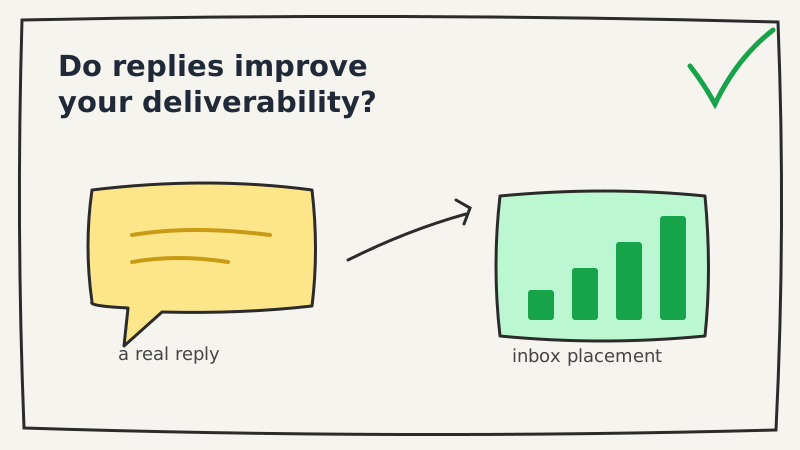
So here is the direct answer. Do email replies improve deliverability? Yes. A genuine reply is one of the strongest positive engagement signals a mailbox provider can see, stronger than an open and harder to fake than a click. The harder question is how much it helps, which replies actually count, and what a cold email team should do about it. That is what this post covers.
How Replies Improve Deliverability: The Signals Mailbox Providers Track
Gmail, Outlook, and Yahoo do not route mail based on your intentions. They route it based on how recipients have treated mail from you and from senders like you. Every provider runs a reputation model built on observed behavior, and reply is near the top of the signal list.
Think about what a reply proves that nothing else does. An open can be triggered by a preview pane or an image prefetch. A click can be an automated security scanner following links. A reply requires a human to read your message, decide it deserves a response, and type one. Providers know this, so they weight replies heavily as evidence that your mail is wanted.
The signals that move sender reputation, roughly in order of how much a provider trusts them:
| Signal | What it tells the provider | How hard to fake |
|---|---|---|
| Reply | A human read it and engaged | Very hard |
| Moved out of spam / marked “not spam” | Recipient actively wants your mail | Hard |
| Star, flag, add to contacts | Explicit positive intent | Hard |
| Click | Some interest, or a scanner | Medium |
| Open | Possibly interest, possibly a prefetch | Easy |
| Deleted without opening | Mild negative | Easy |
| Marked as spam | Strong negative | Easy |
Replies sit at the top for a reason. When a portion of your recipients reply, you are telling the provider that real conversations happen in your threads. That reputation compounds and follows your sending domain and IP.
Why Replies Matter More for Cold Email Than Marketing Email
For a permission-based newsletter, the provider already has a lot of positive history to work with: opt-ins, repeat opens, low complaints. Cold outreach starts with none of that. You are a new sender talking to people who never asked to hear from you, which means every early signal carries extra weight.
That is exactly why the reply matters so much in cold email. A reply on a cold thread is the clearest possible proof that a stranger found your message worth answering. A handful of real replies in your first weeks of sending does more for your reputation than thousands of opens, because opens on a young domain are cheap and replies are not.
This is also why reply rate and deliverability are linked in a loop that runs both directions. Better deliverability puts you in the inbox where you can earn replies. Earning replies improves deliverability so more of your next batch lands in the inbox. The teams that break into this loop early tend to stay in it. The teams that never earn replies watch placement decay. If you want to understand the metric side of this, our breakdown of open rate versus reply rate explains why reply is the number worth optimizing.
The Trap: Reply-Bait and Fake Engagement
Once people learn that replies help, the temptation is to manufacture them. This is where teams get themselves in trouble.
Warmup networks that auto-reply to each other create artificial reply signals. In moderation, warmup is legitimate and useful for establishing a baseline. But providers have spent years learning what warmup pools look like: tight clusters of accounts replying to each other in patterns no human conversation follows. Lean on that too heavily and the signal stops helping and starts flagging you.
The other version is reply-bait in the message itself: “Just reply STOP to opt out,” or “Reply with a number 1 to 5.” You may get replies, but if those replies are annoyed or dismissive, you are now generating negative human engagement, and some of those recipients will hit the spam button on the way out. A reply only helps when the conversation around it looks genuine.
The signal that actually protects you is a real reply on a real thread that continues like a normal exchange. You cannot shortcut that. You can only earn it by sending relevant mail to the right people and then handling their responses well. It is worth noting that automating your side of that conversation does not hurt you. We covered that in detail in do AI reply agents hurt email deliverability: what a provider sees is a normal threaded exchange, and it does not know or care whether a human or a tool composed your half of it.
What Actually Earns Replies (and the Reputation That Follows)
If replies improve deliverability, then the practical question becomes how to earn more genuine ones without gaming anything. Four things move that number.
Send to a clean list. Every message to a dead or mistyped address is a bounce, and bounces damage reputation before a single reply can help you. Validating your list before you send protects the reputation that replies are trying to build. A verification tool like Scrubby catches invalid and risky addresses, including the catch-all domains most validators miss, so your sends reach real humans who can actually reply.
Write to one person, not a segment. Replies come from relevance. A message that reads like it was written for the specific person, referencing their role, their company, or a real trigger, earns responses. A message that reads like a template earns deletes.
Ask one easy question. Threads continue when the reader has something simple to answer. A short, specific question at the end of a cold email produces more replies than a hard call-to-action, and each reply feeds the engagement loop.
Respond fast, and respond to everything. This is the piece most teams miss. A reply only builds a healthy thread if the conversation continues. When a prospect replies and you take two days to answer, or never answer at all because it looked like an objection, the thread dies and the positive signal stalls. Fast, consistent responses keep threads alive, and live threads are exactly the pattern providers reward. Our guide on how to respond to cold email replies walks through doing this at speed.
The Operational Problem With “Just Reply Faster”
Everything above points to the same conclusion: reply to every response, quickly, in a way that keeps the thread going. That is simple to say and hard to run at volume.
A team sending a few thousand cold emails a month gets replies at all hours, in every category: interested, not interested, wrong person, out of office, and questions. The interested ones need a fast, human answer. The out-of-office ones need the sequence paused and rescheduled. The unsubscribe requests need to be honored immediately so you never generate a spam complaint. Handling all of that by hand means replies sit unanswered, threads go cold, and the engagement advantage you were trying to build never materializes.
This is the gap Underfive was built to close. It reads every incoming reply, classifies it by intent, and responds within minutes in your voice, so every genuine reply turns into a live thread instead of an unread message. Fast, consistent handling is what converts the reply signal into durable sender reputation, and it does it without a rep watching the inbox. You can see how the classification and response layer works on the features page.
The Short Version
Do email replies improve deliverability? Yes, and materially, because a reply is the hardest positive engagement signal to fake and the one mailbox providers trust most. For cold email, where you start with no reputation history, real replies early are worth more than any number of opens.
You cannot manufacture that signal with reply-bait or over-warming without eventually being caught. You earn it: send to a validated list, write messages worth answering, ask easy questions, and then respond to every reply fast enough to keep the thread alive. Do that consistently and the loop works in your favor, better placement earning more replies, more replies protecting placement.
Next step: look at your last hundred cold replies and count how many got a response within an hour. If most did not, that is the leak between your engagement and your deliverability, and it is the cheapest one to fix.