
Cold Email Meeting Booking Rate: 2026 Benchmarks and the Fix That Actually Moves It
Two of your dashboards report a cold email meeting booking rate, and they disagree by a factor of fifty. One says 1%, the other says 50%, and both are technically correct. Before you report either number to your team or a client, you need to know which one you are looking at, because they measure completely different things and they point you toward completely different fixes.
This guide untangles the two definitions, gives you the 2026 benchmarks for each, walks the full funnel math so you can see exactly where meetings leak, and names the single stage where most teams lose booked calls they had already won.
The two definitions of cold email meeting booking rate
The confusion is not your fault. The term “meeting booking rate” is used for two genuinely different metrics, and most articles pick one silently.
Definition A, the top-line rate: meetings booked / emails sent. This is a full-funnel efficiency number. It answers “for every thousand emails we send, how many calls land on a calendar.” It comes out small, usually around 1%, because it has survived every stage of attrition: delivery, opens, replies, positive replies, and scheduling.
Definition B, the conversion rate: meetings booked / positive replies. This is a mid-funnel number. It answers “of the people who told us they were interested, how many did we actually get onto a call.” It comes out large, often 40% to 70%, because it starts counting only after a prospect has already raised their hand.
Both are worth tracking, but they diagnose different problems. A low Definition A number can mean weak targeting, bad deliverability, or dull copy anywhere up the funnel. A low Definition B number means something much more specific and much more fixable: you are getting interest and then failing to convert it into a booked slot. Reporting one when you mean the other is how teams spend a quarter rewriting subject lines when the real leak was in how they handled replies.
The full funnel: how the meeting booking rate is really built
The cleanest way to stop the two definitions from fighting is to lay out the whole chain and watch a thousand emails move through it. Each stage multiplies against the last.
Start with 1,000 emails sent.
- Delivered: ~950. Strip the bounces. Reply and meeting rates should always be measured against delivered, not sent, for the same reason you calculate a cold email reply rate on delivered mail.
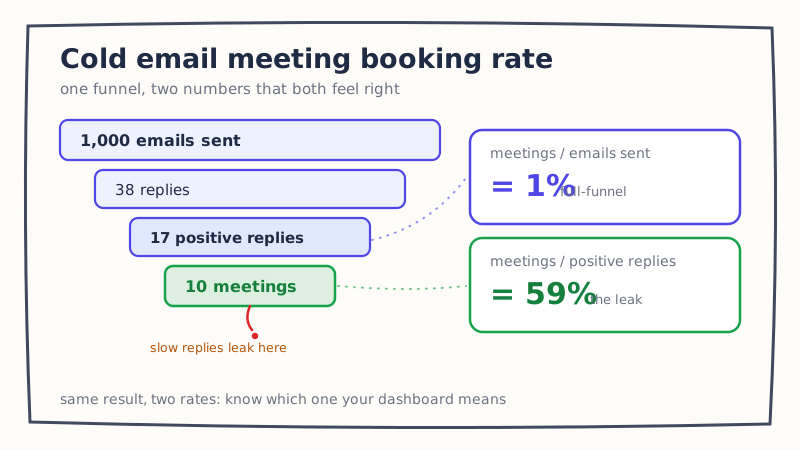
- Replies: ~38. A platform-wide reply rate sits near 4% of delivered mail in 2026, with top-quartile campaigns closer to 5.5%. So roughly 38 people write back.
- Positive replies: ~17. Only some of those replies are interest. Around 40% to 60% of replies are positive or neutral rather than a hard no or an unsubscribe. Call it 45%, and you have about 17 genuinely interested people. This is your positive reply rate, and it is the number that actually predicts pipeline.
- Meetings booked: ~10. Now the last stage. If you convert about 60% of those positive replies into a scheduled call, you book 10 meetings.
Read that chain back and both definitions fall out of the same picture. Definition B, meetings over positive replies, is 10 / 17, roughly 59%. Definition A, meetings over emails sent, is 10 / 1,000, exactly 1%. Nothing contradicts. They are just two different slices of one funnel.
The value of writing it out this way is that you can see which stage is actually costing you meetings instead of guessing. A campaign that books 5 meetings per thousand could be failing at replies, at positive share, or at the booking step, and the fix for each is different.
Cold email meeting booking rate benchmarks for 2026
Here is where published 2026 data converges, expressed both ways so you can match it to whichever dashboard you have.
| Metric | Definition | Weak | Solid | Top quartile |
|---|---|---|---|---|
| Meetings / emails sent (Def. A) | Full-funnel efficiency | Below 0.5% | 0.8% to 1.5% | 1.5% to 3%+ |
| Meetings per 1,000 sent | Same, in absolute terms | Under 5 | 8 to 15 | 15 to 30+ |
| Meetings / positive replies (Def. B) | Interest-to-booked conversion | Below 35% | 45% to 60% | 65%+ |
A few honest caveats before you benchmark yourself against these. Meeting booking rate varies with deal size, seniority of the audience, and offer type. A one-call close to an SMB owner and a multi-stakeholder enterprise motion will never post the same top-line rate, and they should not. Industry matters too, which is why it is worth reading these against reply rate benchmarks by industry rather than a single global average.
The one number that is not ambiguous is the floor. A top-line meeting rate under 0.5%, or fewer than 5 meetings per 1,000 sent, is a signal that something is structurally broken rather than merely unoptimized. That is a targeting, deliverability, or reply-handling problem, not a copy-tweak problem.
The stage where meetings quietly leak: positive reply to booked
Most advice about improving meeting booking rate lives at the top of the funnel: better lists, better personalization, better subject lines. That work matters, but it improves Definition A by widening the mouth of the funnel. There is a faster and cheaper win hiding at the bottom, in Definition B, and almost nobody optimizes it.
Think about what a positive reply actually is. Someone read a cold email from a stranger, decided it was worth their time, and typed a response. That is the single most expensive thing to earn in all of outbound, and you already have it. Yet this is precisely the stage where teams leak the most, because a positive reply does not book itself. It needs a fast, relevant answer that moves the person to a specific time.
Two things kill this stage:
- Speed. Interest has a short half-life. A prospect who is curious at 9:14 a.m. is back in meetings, deep in their own work, or reading your competitor’s reply by the afternoon. The gap between “interested” and “booked” is where deals go cold, and it is almost entirely a function of how fast you respond. We have covered why five-minute response times change conversion in detail, and the effect is largest at exactly this stage.
- Friction. A positive reply answered with “Sure, what times work for you?” throws the scheduling work back onto the prospect. Every round of back-and-forth is another chance to lose them. Interested replies should be met with a concrete proposal: two specific times, or a direct booking link, phrased in the context of what they said.
This is the leak that generic benchmark posts never name, and it is the one Underfive was built to close. An AI reply agent reads every reply the moment it lands, tells a genuinely interested prospect apart from an out-of-office or a soft no, and responds in minutes with a booking-ready next step instead of letting the thread sit in a queue until an SDR gets to it. When the interested-to-booked stage runs in minutes instead of hours, Definition B climbs, and because it is the last multiplier in the chain, your top-line meeting rate climbs with it. You can see how the reply-handling automation works across the funnel on the features page.
How to improve your cold email meeting booking rate
Diagnose first, then fix the specific stage. Working from the bottom of the funnel up, because that is where the cheapest wins are:
- Measure both definitions separately. Track meetings over positive replies and meetings over emails sent as two distinct lines. If Definition B is low, your problem is reply handling and scheduling, not copy. If B is healthy but A is low, your problem is upstream volume and targeting. This split is the whole diagnosis.
- Cut time-to-first-reply on positive replies. This is the highest-leverage change for most teams. Answer interested prospects in minutes, not hours, whether by tightening an SDR rota or automating the first response. This is also closely tied to your reply-to-demo conversion rate, which lives in the same part of the funnel.
- Remove scheduling friction. Replace “what works for you” with a concrete offer of two times or a booking link. Fewer round trips means fewer chances to lose the meeting.
- Make sure interest is reaching a decision-maker. A high reply rate that books few meetings can mean you are converting the wrong people. Route replies to the right owner and qualify inside the conversation rather than after it.
- Only then, widen the top of the funnel. Once the bottom of the funnel converts well, better lists and sharper personalization multiply against a booking step that actually holds, so every extra reply is worth more.
The order matters. Fixing targeting while your interested-to-booked conversion leaks just pours more water into a bucket with a hole in it.
The number to walk away with
Cold email meeting booking rate is not one metric, it is two, and keeping them separate is what turns a vague “our numbers are down” into a specific, fixable diagnosis. Track meetings over positive replies to see how well you convert interest, and meetings over emails sent to see how efficient the whole funnel is. When they disagree, that gap is telling you exactly where to look.
If the gap points at the interested-to-booked stage, that is the good news, because it is the fastest to fix and the cheapest interest you will ever earn. Answer your positive replies faster than a human queue can, and the booking rate follows.