There is a moment in every cold outreach sequence that most sales teams quietly lose: the reply window. A prospect responds to a sequence, expresses interest, asks a clarifying question, or even just says “can you send more info?” And then they wait.
If your SDR sees that reply in 20 minutes, you have a fighting chance. If it sits unread until the next morning, that lead has moved on, mentally if not literally.
This is the gap that AI reply agents were built to close. But how significant is that gap in practice? And when does the human still win? This comparison breaks it down with actual numbers and workflow context so you can make decisions grounded in pipeline math, not vendor promises.
The Response Time Gap: What the Data Actually Shows
The benchmark that changed how teams think about reply handling came from a Harvard Business Review study showing that companies which responded to leads within an hour were seven times more likely to qualify that lead than those who waited even an hour longer. That study is over a decade old. The window has only gotten narrower.
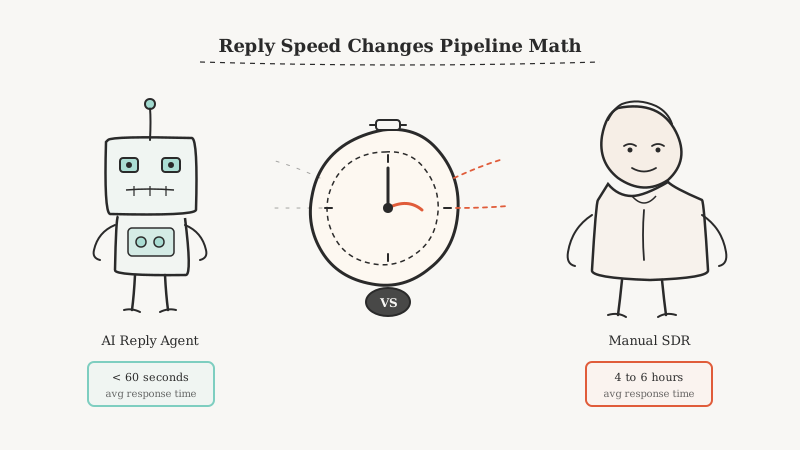
More recent data from sales analytics platforms consistently shows that the average SDR responds to a prospect reply in somewhere between 2 and 24 hours, depending on workload, time zone, meeting density, and whether the rep is new or experienced. The median sits around 4 to 6 hours in most teams that have not explicitly engineered around this problem.
An AI reply agent, by contrast, responds in under 60 seconds in the vast majority of deployments. Some configurations push that to under 10 seconds. Tools like Underfive are purpose-built around this exact problem: they monitor reply inboxes and trigger personalized, contextually aware responses the moment a prospect engages.
The practical delta between a 5-hour response and a 30-second response is not incremental. It represents a completely different level of prospect intent. A lead who replied 5 hours ago has had time to book a call with a competitor, lose interest, get distracted by their own workload, or simply forget why they engaged in the first place.
Consistency: The Hidden Killer in Manual Followup
Speed is the obvious variable. But consistency might be the more damaging one over time.
An SDR operating a full sequence workload manages anywhere from 50 to 200 active prospects at any given moment. Replies arrive at random times. Some come in during back-to-back product demos. Some arrive at 7pm. Some are buried under internal Slack messages and get flagged as “replied to” when they were only read.
The result: reply quality and speed vary wildly across a rep’s day, week, and quarter. A prospect who replies on a Tuesday morning when the rep is fresh and focused gets a different experience than one who replies on a Friday afternoon when the rep is in pipeline review prep.
This inconsistency compounds. When teams run A/B tests on outreach sequences, they often attribute conversion differences to copy or timing when the actual variable is reply handling variance. It is one of the most under-measured problems in outbound sales.
AI reply agents eliminate this variance entirely. The system does not have bad Fridays. It does not deprioritize replies during quota crunch. Every inbound reply gets the same response logic applied with the same speed and the same tone.
For teams running high-volume outbound (500+ active contacts per month), this consistency difference alone can be worth several percentage points of pipeline conversion.
Conversion Impact: What Faster Replies Actually Do to Pipeline Math
Here is where the comparison gets financially concrete.
Consider a team sending 2,000 cold emails per month with a 3% reply rate. That generates 60 replies. Of those 60, roughly 40% are genuinely interested or curious (not unsubscribes or out-of-office). That leaves 24 warm replies worth engaging.
With manual SDR handling at a 4-hour average response time, industry conversion rates on warm replies to booked meetings typically run 15 to 25%. Call it 20% as a working number. That converts 4.8 meetings from those 24 warm replies.
The same 24 warm replies handled by an AI reply agent with sub-60-second response times: published conversion benchmarks from teams using AI-assisted reply handling commonly show 35 to 50% improvement in reply-to-meeting conversion. Even at the conservative end (35% improvement), that same 24 warm replies now converts roughly 6.5 meetings.
That is 1.7 additional meetings per month from the same email volume, with no additional SDR headcount, no extra sequences, no change to targeting.
Over a quarter: roughly 5 additional meetings. For a team where each booked meeting has a $500 pipeline value, that is $2,500 in pipeline from one operational change. For enterprise teams where each meeting carries $5,000 to $50,000 in pipeline value, the math becomes transformative quickly.
Before any of that pipeline math matters, your email list has to be clean. A bounce rate above 3 to 4% damages sender reputation and reduces deliverability for the entire domain. Running lists through Scrubby before launching sequences ensures the warm replies you are counting on actually reach inboxes in the first place.
What AI Reply Agents Handle Well (and What They Do Not)
It is worth being direct about where AI reply agents genuinely excel and where they fall short.
AI reply agents perform best on:
Replies that follow predictable patterns: “Can you send a case study?”, “What does pricing look like?”, “Who else in my industry uses this?”, “I’m interested, what’s next?” These are the replies that represent 60 to 70% of genuine engagement responses. An AI agent can handle these with personalization, context from the original sequence, and a clear CTA, all within seconds.
High-volume sequences where SDR attention is rationed. When a rep is managing 150 active contacts and 20 of them reply on the same day, the AI handles the initial response so the rep can focus on the highest-signal conversations.
After-hours and weekend replies. This alone can represent 20 to 30% of replies depending on industry and geography. Prospects in different time zones, busy executives who catch up on email at 10pm: these replies used to sit until the next business day. Now they get a response before the prospect closes their laptop.
Where human SDRs still win:
Complex objections. When a prospect replies with a nuanced pushback about a competitor, a specific integration concern, or a regulatory question, a human can read the subtext and respond with judgment. An AI agent can handle tier-one objections, but deep, context-specific conversations still benefit from a human in the loop.
Relationship-sensitive accounts. For named accounts where the relationship matters beyond the immediate deal, tone and judgment are irreplaceable. High-ACV enterprise deals where one wrong response ends the conversation: those warrant human handling at every touch.
Ambiguous signals. Some replies are genuinely hard to parse: a two-word response, a reply that mixes interest with skepticism, or a forwarded email that introduces a new stakeholder without context. Experienced SDRs read these situations better than current AI systems.
The Hybrid Approach: Where Most High-Performance Teams Land
The most effective outbound teams are not running a binary choice between AI and manual. They are building tiered response workflows.
The structure looks roughly like this:
Tier 1 (AI handles fully): Standard interest replies, information requests, scheduling prompts, out-of-office acknowledgments, basic objections. The AI agent responds within 60 seconds, books the meeting if the prospect is ready, or routes to the next step.
Tier 2 (AI drafts, SDR reviews): Replies that involve objections, competitor mentions, or complex questions. The AI agent generates a draft response in under a minute. The SDR reviews, edits if needed, and sends. Response time stays under 10 to 15 minutes instead of hours.
Tier 3 (SDR handles directly): Named accounts, high-ACV deals, replies that require judgment calls, or escalations flagged by the AI as outside its confidence range.
This architecture means the SDR’s attention is spent on the conversations that actually require their judgment. The rest is handled faster and more consistently than any human process can deliver.
Underfive is built to operate exactly in this tiered model, with configurable routing logic that lets revenue operations teams define which reply types go directly to AI handling and which get surfaced for SDR review.
Implementation: What to Get Right Before You Deploy
Teams that deploy AI reply agents without preparation often see disappointing results. Here is what matters most in the first 30 days.
Train on your actual objection library. AI reply agents perform much better when they have access to how your team has historically handled specific objections. Pull a sample of your best SDR reply threads from the past 6 months and use them to configure your agent’s response logic.
Set clear routing rules. Define upfront what triggers a Tier 3 human escalation. “Competitor mentioned” is a common one. “Reply contains budget concern” is another. Vague routing logic leads to the AI handling things it should not and leaving SDRs unsure when to intervene.
Monitor reply sentiment in the first two weeks. Most AI reply agent platforms surface engagement data. Watch for replies to AI responses that contain confusion, frustration, or disengagement signals. These are indicators that the agent’s response logic needs tuning.
Align your SDR team on the workflow change. Reps sometimes push back on AI reply agents because they feel like the technology is replacing their judgment. Frame it correctly: the AI handles the repetitive first-response work so reps can spend more time on conversations that actually require skill and relationship-building.
Make sure your outreach infrastructure is clean before scaling. Higher reply rates from better email deliverability mean more work for your reply agent. An invalid email rate above 2% is enough to create deliverability problems that undermine the entire system. Validation tools like Scrubby integrate cleanly into pre-send workflows and keep bounce rates in the safe zone.
The Actual Pipeline Math Summary
For teams that have not yet implemented an AI reply agent, the cost of manual-only handling is not theoretical. Every day a warm reply sits unanswered for 4 to 6 hours instead of 60 seconds is a probability decay event on that deal. Prospects cool off. They talk to a competitor. They decide the problem is not urgent enough to pursue right now.
The math is straightforward: faster, more consistent replies convert warm interest into booked meetings at meaningfully higher rates. The tools exist to close this gap at scale without adding headcount. The hybrid model means you are not sacrificing quality for speed; you are applying human judgment where it matters most and automating where speed and consistency create the most value.
For most outbound teams running 500 or more contacts per month, the pipeline math on implementing an AI reply agent pays out in the first quarter. The teams seeing the largest returns are those that treat deployment as an infrastructure decision: something to configure thoughtfully, monitor actively, and optimize continuously rather than a plug-and-play addition.
Speed wins the reply window. Consistency compounds over time. Both are achievable at scale without replacing the SDR judgment that closes deals.