How AI Reply Agents Handle Timezone Differences for Global Sales Teams
A prospect in Singapore replies to your cold email at 2:14 AM Eastern. Your SDR is asleep. By the time they get to the office at 9 AM, that reply has been sitting for nearly seven hours. The prospect has moved on. They opened three competitor emails, booked a demo with someone else, or simply lost the momentum that made them reply in the first place.
This is not an edge case. For any sales team selling outside their own timezone (which, in B2B SaaS, is most of them), timezone gaps are one of the largest silent killers of pipeline velocity. The data is consistent: response time is the single strongest predictor of whether a reply converts to a meeting. After five minutes, conversion rates drop sharply. After an hour, they crater. A seven-hour delay is not a delay; it is a forfeit.
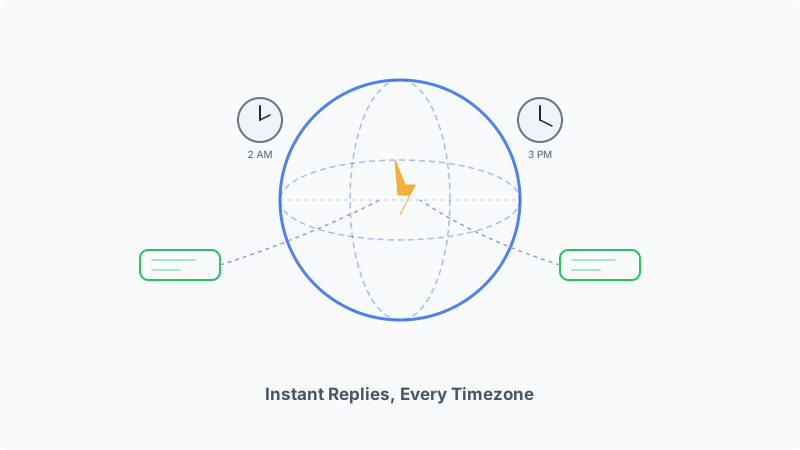
AI reply agents solve this by eliminating the gap entirely. They respond to prospect replies in seconds, at any hour, in any timezone. The response is contextual, personalized, and aligned with your sales playbook. The prospect gets the fast reply they expect, and your pipeline keeps moving while your team sleeps.
The Timezone Problem is Bigger Than Most Teams Realize
Sales leaders tend to underestimate the timezone problem because the data hides in plain sight. Your CRM tracks when replies come in, but most teams never segment reply-to-meeting conversion by time-of-day or timezone offset. When they do, the pattern is stark.
A sales team based in New York selling to prospects in the US, Europe, and Asia-Pacific faces three distinct windows:
US prospects reply during Eastern business hours (9 AM to 6 PM ET). The SDR is available, responses happen within minutes, and conversion rates are strong.
European prospects reply during their business hours (3 AM to 12 PM ET). Morning replies from London or Berlin arrive before the SDR’s alarm goes off. By the time the SDR responds, the prospect is heading to lunch or already deep in afternoon meetings.
Asia-Pacific prospects reply during their business hours (7 PM to 4 AM ET). These replies arrive during the SDR’s evening and overnight. Response happens the next morning at best, a full 8 to 12 hours later.
The compounding effect is significant. If 40 percent of your target accounts are outside your local timezone, and those accounts see response times three to ten times longer than local accounts, you are systematically underperforming in those markets. The pipeline reflects it: international segments show lower reply-to-meeting rates, and the team attributes it to “market differences” when the real cause is response latency.
Why Hiring Across Timezones Does Not Fully Solve It
The obvious solution is hiring SDRs in each timezone. Hire someone in London for EMEA coverage, someone in Singapore or Sydney for APAC. This works, to a point.
The challenges are real. Each additional timezone hire adds salary, management overhead, tool costs, and coordination complexity. Training consistency becomes harder when the team is distributed. Knowledge transfer between timezone-separated reps is asynchronous by definition, which means playbook updates, objection handling refinements, and ICP shifts propagate slowly.
For early-stage and mid-market companies, the math often does not work. You cannot justify a full-time hire in a timezone where you have 50 target accounts. The volume does not support the headcount, but the accounts are still valuable and still deserve fast responses.
Even companies that do hire globally find gaps. Sick days, vacations, and turnover create coverage holes. The SDR in Singapore takes a week off, and APAC replies go unanswered for days. The replacement coverage from the US team defeats the purpose because those reps are asleep when the replies arrive.
How AI Reply Agents Close the Gap
AI reply agents operate as always-on team members that process incoming replies and generate contextual responses in seconds. They do not sleep, do not take vacations, and do not have timezone preferences.
When a prospect reply arrives at 3 AM, the AI agent reads the full thread context: the original outreach, the prospect’s reply, any prior interactions, and the relevant account data. It generates a response that matches your brand voice, addresses the prospect’s specific question or objection, and advances the conversation toward a meeting or next step.
The response goes out within seconds or minutes of the reply, depending on your configuration. From the prospect’s perspective, they wrote back and got an immediate, relevant response from your company. That experience is what converts.
What AI Reply Agents Handle at 3 AM
The range of replies that AI agents handle well covers the vast majority of cold email responses:
Interest signals. “Tell me more about how this works.” The agent provides a concise value summary tailored to the prospect’s industry and role, then suggests a specific meeting time using the prospect’s timezone.
Scheduling requests. “Can we chat next week?” The agent offers specific time slots, again in the prospect’s local timezone, and can connect directly to your scheduling tool to confirm bookings.
Qualification questions. “Does this work with Salesforce?” or “What’s your pricing?” The agent draws on your product knowledge base to answer accurately, then pivots toward a meeting where the full solution can be discussed.
Soft objections. “We’re happy with our current provider” or “Not the right time.” The agent acknowledges the objection, provides a relevant proof point or case study, and keeps the door open with a low-commitment next step.
Referrals. “I’m not the right person, try reaching out to Sarah.” The agent thanks the prospect, notes the referral, and routes it to your team for follow-up during business hours.
For complex scenarios that require human judgment (negotiation-stage discussions, technical deep-dives, escalation requests), the agent flags the reply for human review and can send a brief holding response to acknowledge receipt while your team picks it up during their working hours.
Implementation Without Disrupting Your Current Workflow
Adding AI reply agents to handle timezone coverage does not require rebuilding your outbound stack. The typical implementation works alongside your existing tools.
Step 1: Connect your email infrastructure. The AI agent monitors your outbound sending accounts (or a shared reply inbox) for incoming prospect responses. This works with any email provider or sequencing tool.
Step 2: Train on your playbook. Feed the agent your messaging guidelines, product positioning, common objections and responses, competitor differentiators, and any rules about what to say (and what not to say). The more specific the training data, the more accurate the responses.
Step 3: Set timezone rules. Configure when the AI agent is active. Many teams run it 24/7 but only for replies that arrive outside their SDR’s working hours. During business hours, the human SDR handles replies directly. Outside hours, the agent takes over.
Step 4: Define escalation triggers. Specify which types of replies should be handled autonomously and which should be flagged for human follow-up. Start conservative (handle only clear interest signals and scheduling requests) and expand the agent’s scope as you build confidence in its responses.
Step 5: Monitor and refine. Review the agent’s responses weekly. Flag any that miss the mark and update the training data. Most teams reach 90 percent or higher accuracy within two to three weeks of iteration.
Underfive makes this setup straightforward with pre-built integrations for common outbound tools and a training interface that lets you define your playbook without writing code. The agent learns your voice and improves with every interaction.
The Metrics That Change
Teams that deploy AI reply agents for timezone coverage typically see measurable shifts within 30 days.
Average response time for international prospects drops from hours to minutes. This is the most direct metric. When a reply that used to wait 8 hours gets a response in 90 seconds, the prospect experience is fundamentally different.
Reply-to-meeting conversion for off-hours replies increases by 25 to 40 percent. The speed advantage directly translates to more meetings booked from the same volume of replies.
Total meetings booked per month increases without increasing outbound volume. You are not sending more emails; you are converting more of the replies you already generate.
SDR time allocation shifts toward high-value activities. When the AI handles the initial reply and qualification for overnight responses, the SDR’s morning becomes about advancing warm conversations rather than triaging a backlog.
Maintaining Quality Across Timezones
The concern with AI-generated responses is always quality. Will the agent say something wrong? Will it sound robotic? Will it damage the relationship before the human SDR can take over?
These concerns are valid and addressable.
Voice consistency. The best AI reply agents are trained on your actual sent messages, not generic templates. They learn your tone, your sentence structure, your level of formality. A prospect should not be able to tell whether the 3 AM response came from a person or an agent.
Accuracy guardrails. Configure hard limits on what the agent can and cannot discuss. Pricing details beyond published tiers, contract terms, custom integrations: these can be gated so the agent deflects to a meeting rather than providing potentially incorrect information.
Thread awareness. Good AI agents maintain context across the full conversation thread. If the prospect references something from the original email, the agent connects the dots. This prevents the disjointed, context-free responses that immediately signal automation.
Ensuring your outreach reaches real inboxes in the first place is equally important. Running your prospect lists through Scrubby before launching campaigns removes invalid and catch-all emails, so the replies you receive come from genuine prospects rather than dead addresses.
Combining AI Coverage with Calendar Outreach
For teams using multi-channel outbound, AI reply agents extend naturally to calendar invite responses. If you are booking meetings through calendar invite outreach via tools like Kali, prospects may accept, decline, or propose alternate times at any hour. An AI agent can process calendar responses, confirm bookings, suggest new times for declines, and handle rescheduling, all without waiting for a human to wake up.
The combination of fast email replies and immediate calendar handling creates a prospect experience that feels responsive and professional regardless of where in the world either party is located.
The Bottom Line
Timezone gaps are a structural disadvantage that most sales teams accept as a cost of doing business. They should not. AI reply agents eliminate the gap at a fraction of the cost of hiring across timezones, with consistent quality, zero coverage holes, and immediate impact on pipeline velocity.
If your team sells across more than two timezones and your average after-hours response time exceeds 30 minutes, you are leaving meetings on the table every night. The fix is not more headcount. It is an agent that never sleeps, always responds in context, and keeps your pipeline moving around the clock.