AI Reply Agent vs Hiring an SDR: The Real Cost Per Reply in 2026
Almost every “should we automate our reply handling” conversation starts with the wrong number. Someone pulls up a salary benchmark, says an SDR costs roughly 60,000 dollars a year in base pay, and the debate turns into a gut check about whether software can replace a person for less.
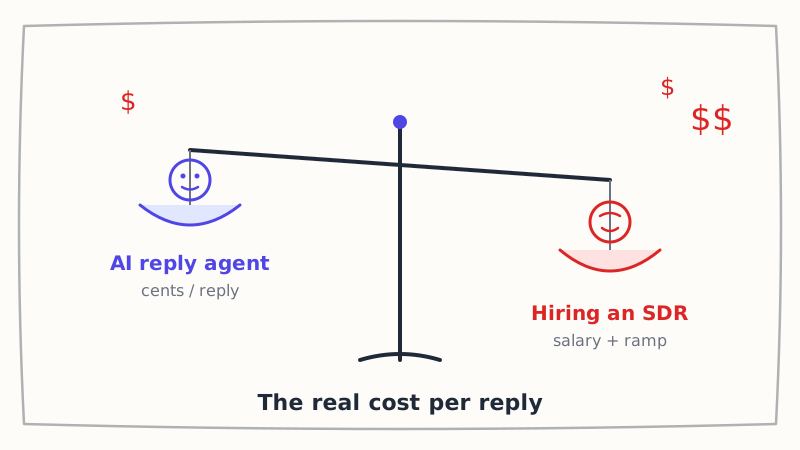
That framing hides the number that actually runs your pipeline: cost per reply handled. A prospect who responds to a cold email is worth real money, and what you spend to answer them quickly and well is the metric that decides whether outbound pays for itself. So let us do the honest math on both sides, ramp and turnover included, and then talk about where each option genuinely wins.
Why salary is the wrong starting point
Base pay is the smallest line item in the true cost of an SDR. When you add everything up, the fully loaded cost of a single SDR in 2026 usually lands somewhere between 90,000 and 130,000 dollars a year. The pieces that get left off the whiteboard:
- Payroll taxes and benefits, which typically add 25 to 35 percent on top of base.
- Tooling, because an SDR is not productive without a sequencer, a dialer, a data provider, and a CRM seat. That stack alone runs a few thousand dollars per rep per year.
- Management overhead, since one manager for every six to eight reps is not free.
- Ramp, the two to four months before a new hire is actually effective. You pay full cost and get partial output.
- Turnover, and this is the quiet killer. SDR tenure averages well under two years, so you are re-paying the ramp tax on a loop.
None of that shows up when someone says “an SDR is 60k.” All of it shows up in your budget.
Translating cost into cost per reply
To compare fairly, convert both options to the same unit. A productive SDR who is also prospecting, dialing, and sitting in meetings can meaningfully work through somewhere around 40 to 60 inbound replies a day when reply volume is high. Call it 50 on a good day, which across a working year is roughly 12,000 replies handled.
Take a mid-range fully loaded cost of 110,000 dollars and divide by 12,000 replies. That is a little over 9 dollars per reply handled, and that assumes the rep is at full productivity every single day, never sick, never ramping, never distracted by pipeline reviews. The realistic number is higher.
An AI reply agent handling the same reply, like the inbox agents inside Underfive’s Unified Inbox, is priced in cents, not dollars. Even generous per-reply pricing that bundles model inference, drafting, classification, and CRM logging lands one to two orders of magnitude below the human cost per reply. The gap is not subtle. It is the difference between dollars and pennies.
Speed changes the equation before price does
Cost per reply is only half the story. The other half is what a slow reply costs you in lost deals, and that is where the comparison stops being close.
Response time is the single biggest lever on cold email conversion. A prospect who replies “sounds interesting, tell me more” is warm for minutes, not hours. A human SDR who is asleep, in a meeting, or three time zones away simply cannot answer in that window, and every hour of delay measurably drops the odds of booking. An AI reply agent answers in seconds, at 2 a.m., in the prospect’s language, without a queue.
So the real comparison is not “cheap software versus expensive human.” It is “software that answers every reply in seconds for cents” versus “a human who answers some replies in hours for dollars.” Once you price in the deals that die in the gap, the AI side wins on revenue, not just on cost.
Where the human SDR still wins
This is a comparison, not a eulogy for the SDR role. There is work a human should own, and pretending otherwise leads to bad automation.
- Complex, high-value negotiations where reading the room and improvising matters more than speed.
- Multi-threaded enterprise deals with procurement, security review, and a buying committee that wants a relationship, not a fast reply.
- Discovery calls and live conversation, which no reply agent is trying to replace.
- Judgment calls on unusual replies that fall outside any playbook.
The strongest teams in 2026 are not choosing one or the other. They let the AI reply agent handle the high-volume, time-sensitive first response so that no lead goes cold, and they route the genuinely complex threads to a human who is no longer buried under 50 low-context replies a day. The reps you keep get more expensive time back for the work only they can do.
The cost you forget to count: deliverability
There is one more line item that quietly wrecks the math on both sides, and it has nothing to do with who writes the reply. If your cold emails are landing in spam, you are paying full cost per reply on a fraction of the replies you should be getting. A pristine reply workflow on top of a dirty sending list is money spent answering the wrong volume.
Before you optimize reply cost at all, make sure the list you are emailing is clean. Running your contacts through an email validation service like Scrubby removes the invalid and risky addresses that spike bounce rates and drag your sender reputation down. Fewer bounces means more replies reach a human or an agent in the first place, which lowers your true cost per booked meeting no matter which side of this comparison you land on.
A simple way to decide
You do not need a spreadsheet with 40 assumptions. Answer three questions:
- What is your daily reply volume, and is it growing? If replies are outpacing the SDR capacity you can afford to hire, the per-reply economics already favor automation. Volume is where the AI reply agent’s cost advantage compounds fastest.
- How fast are you answering today, honestly? If your median first-reply time is measured in hours, you are losing deals that an agent answering in seconds would keep. That lost revenue usually dwarfs the software cost.
- What do you want your best reps doing? If your most expensive people are spending their day on “send me pricing” and “who is the right contact” replies, you are paying dollars-per-reply for work an agent does for cents, and starving your negotiations and demos of attention.
When those questions point at automation, the cleanest next step is to let the agent own first-response and meeting-booking, then measure the change. Pairing a reply agent with a calendar-first booking tool like Kali closes the loop from “prospect replied” to “meeting on the calendar” without a human touching the routine cases, so your cost per booked meeting drops even further.
The bottom line
Comparing an AI reply agent to hiring an SDR on salary alone is comparing the wrong numbers. Convert both to cost per reply handled, add ramp, turnover, and the deals lost to slow response, and the picture is clear: the human SDR is a premium resource you should reserve for premium work, and the high-volume reply handling that eats your team’s day is exactly the work the inbox agents inside a Unified Inbox like Underfive do faster and for a fraction of the cost.
The best-run outbound teams in 2026 are not asking “human or machine.” They are asking “which replies deserve a human, and how do we make sure the rest get answered in seconds.” Get that split right and cost per reply stops being a budget line you dread and starts being a number that shrinks as you grow.