AI Reply Agent vs Outreach and Salesloft: Who Actually Handles the Reply?
If you run outbound at any scale, you almost certainly use a sales engagement platform. Outreach and Salesloft are the two biggest, and they are genuinely excellent at what they were built to do: schedule multi-step sequences, fire emails and calls at the right cadence, and keep a rep’s day organized.
But there is a quiet gap in every sequencer-driven workflow, and it shows up at the most important moment. The prospect replies. The sequence stops. And now a human has to read the message, figure out what the prospect meant, and write something back fast enough to keep the deal warm.
That handoff is where pipeline leaks. Below is an honest look at what Outreach and Salesloft do, what they deliberately do not do, and where an AI reply agent fits.
What sequencers are built for
Sales engagement platforms are outbound orchestration engines. Their core job is to make sure the right message goes out to the right contact at the right step. They are very good at:
- Building and A/B testing multi-touch sequences across email, call, and LinkedIn
- Enforcing cadence so no prospect gets skipped or double-sent
- Logging activity to the CRM and reporting on sequence performance
- Giving reps a prioritized task list each morning
Notice the common thread: everything above is about getting messages out. The platform is optimized for the send side of the conversation.
What happens when the prospect replies
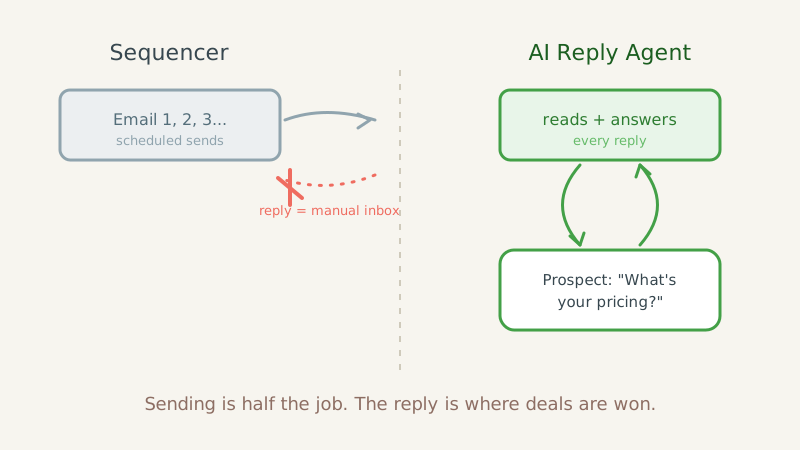
Here is the mechanic almost no one talks about. When a prospect replies inside Outreach or Salesloft, the sequence automatically pauses for that contact. This is by design and it is correct: you do not want an automated sequence firing “just following up” at someone who already wrote back.
But pausing the sequence is the entire response. The platform does not read the reply. It does not understand whether the prospect asked about pricing, requested a deck, said “not right now,” or asked to be removed. It simply routes the message into a human’s inbox and waits.
So the real comparison is not “Outreach vs an AI reply agent.” It is “who handles the reply after the sequence pauses?” With a sequencer alone, the answer is: a rep, whenever they next open their inbox.
The cost of the manual handoff
The handoff sounds harmless until you look at the numbers behind it. Reply speed is one of the highest-leverage variables in all of outbound. A prospect who gets a relevant answer within five minutes is dramatically more likely to reach a real conversation than one who waits hours, and most cold replies do wait hours, because reps are in meetings, asleep, or buried under a triage queue.
Three failure modes show up again and again:
- Latency. The most interested prospects, the ones who reply quickly, often wait the longest for a human to respond, because replies pile up faster than reps can clear them. We dug into the data on this in our piece on how 5-minute response times increase conversions.
- Inconsistency. Reply quality swings with whoever happens to be on inbox duty. A great rep nails the objection. A tired one sends “Let me check and get back to you,” and the thread dies.
- Volume ceilings. As you scale sends, replies scale with them. A team that can comfortably handle 30 replies a day starts dropping threads at 100. This is the exact problem we covered in inbound reply volume outpacing SDR capacity.
The sequencer made the volume problem worse, in a sense, because it made sending effortless. The reply side never got the same automation.
Where an AI reply agent fits
An AI reply agent is built for the half of the conversation sequencers leave alone. It watches the inbox connected to your campaigns, reads each reply in context, and writes a relevant, on-brand response, autonomously or as a draft for a rep to approve.
That means when a prospect writes back:
- It recognizes a pricing question and answers it directly instead of stalling. See how it handles pricing questions without killing the deal.
- It treats “send me more info” as a real buying signal and responds with the right asset and a next step.
- It books the meeting when the prospect is ready, negotiating times across calendars.
- It escalates the genuinely tricky threads to a human, instead of escalating all of them.
Crucially, this is not a replacement for Outreach or Salesloft. It is the missing layer on top. The sequencer keeps doing what it is great at, getting the right message out on cadence, and the AI reply agent owns the moment the prospect responds. Tools like Underfive are designed to sit alongside your existing sales engagement stack rather than rip it out.
A side-by-side view
| Capability | Outreach / Salesloft | AI Reply Agent |
|---|---|---|
| Multi-step outbound sequences | Yes, core strength | No, not its job |
| Cadence and task management | Yes | No |
| Pauses sequence on reply | Yes | Not applicable |
| Reads and understands the reply | No | Yes |
| Writes a relevant response | No, human does | Yes, autonomously or as draft |
| Responds within minutes, 24/7 | No | Yes |
| Books meetings from the thread | No | Yes |
| Scales reply handling with send volume | No | Yes |
The pattern is clear. The two categories barely overlap. One owns the send, the other owns the reply.
What about deliverability?
A fair question when you add any automation to your inbox: does replying automatically put your domain at risk? The short version is that thoughtful reply handling actually protects sender reputation, because faster, relevant responses reduce the spam complaints and dead threads that hurt you. We unpack the nuance in do AI reply agents hurt email deliverability. And none of it matters if you are emailing bad addresses in the first place, which is why validating your list with a tool like Scrubby before a campaign goes out is still step zero for any outbound motion.
The bottom line
Outreach and Salesloft are not competitors to an AI reply agent. They are the front half of the same workflow. The sequencer gets your message in front of the prospect. The AI reply agent makes sure that when the prospect responds, someone, or something, answers well and answers fast.
If your sequences are humming but replies still sit unanswered for hours, the gap is not in your sending. It is in your replying. That is the layer worth closing, and you can see what it looks like in practice at Underfive. If your bottleneck is actually getting more meetings booked from those conversations, pairing it with an outbound layer like Kali closes the loop from first touch to booked call.